
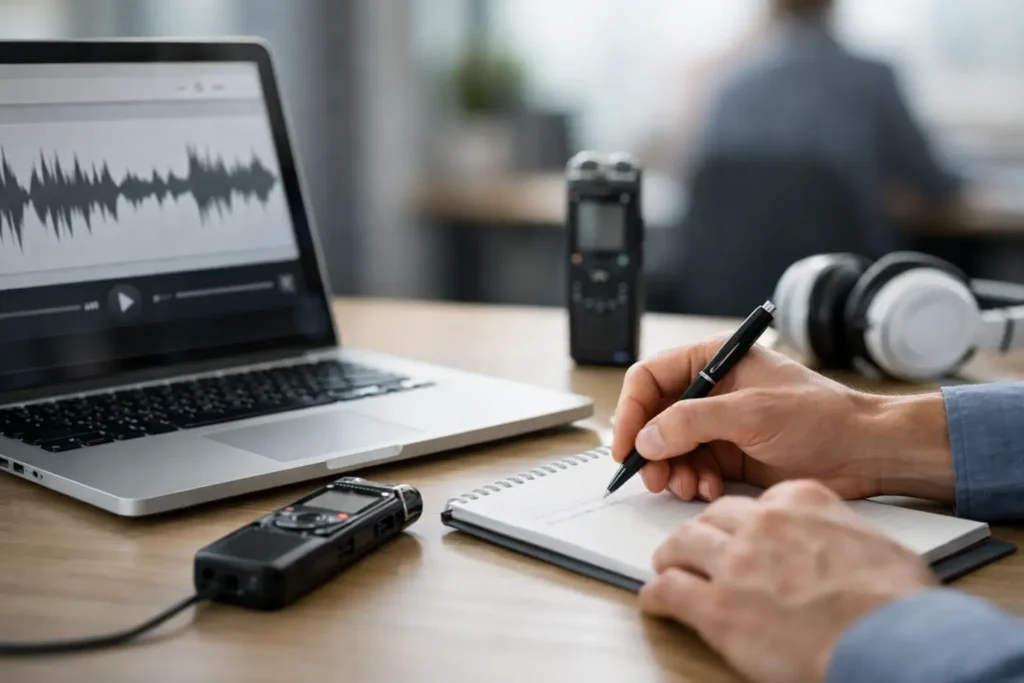
A recorded interview can contain facts that matter long after the conversation ends: a witness’s exact wording, a patient’s history, a candidate’s qualifications, or a client’s instructions. Knowing how to transcribe recorded interviews accurately means creating a written record that preserves those details without adding assumptions, omissions, or formatting confusion.
For casual research, a rough transcript may be enough. For legal, medical, immigration, academic, or business matters, the standard is higher. The transcript must be readable, complete, confidential, and clear about who said what. If it will support an official process, it may also need timestamps, speaker identification, certification, or translation into English.
How to Transcribe Recorded Interviews Step by Step
Start by defining the purpose of the transcript. This decision affects every part of the job, from the level of detail to the final format. An internal team interview may need a clean, readable transcript that removes verbal fillers. A deposition, investigation, disciplinary meeting, or patient interview may require a more literal record of speech, including pauses, interruptions, and notable nonverbal sounds.
Before typing a word, listen to the first several minutes of the recording. Confirm how many speakers are present, whether names are stated clearly, what language or languages are spoken, and whether the audio includes background noise or overlapping conversations. This initial review prevents avoidable errors later.
Choose the Right Transcription Style
The two most common formats are verbatim transcription and clean verbatim transcription. Verbatim transcription captures the speaker’s words as spoken, including fillers such as “um,” “uh,” repeated words, false starts, and interruptions when relevant. It is often appropriate for legal matters, investigations, qualitative research, and interviews where tone or wording may be significant.
Clean verbatim transcription removes unnecessary fillers and minor repetitions while preserving the speaker’s intended meaning. It is usually better for business meetings, journalism, academic summaries, and internal records. Do not silently “improve” grammar if doing so could change the meaning, level of certainty, or tone of the answer.
For example, “I think I saw him around seven” is not the same as “I saw him at seven.” The first statement reflects uncertainty. The transcript should retain it.
Prepare the Audio and Your Workspace
Use the clearest audio file available. If you have multiple versions, choose the original recording rather than a compressed version forwarded through a messaging app. Headphones are strongly recommended because they make low-volume words, accents, and speaker changes easier to hear.
Create a secure working environment before you begin. Interview recordings may contain personal identifiers, medical information, financial details, immigration history, trade information, or legally sensitive statements. Store files in protected folders, limit access to authorized personnel, and avoid uploading confidential recordings to unapproved public tools.
It also helps to create a simple file naming system. Include the interview date, case or project reference, and version number, but do not place unnecessary confidential information in the file name. A clear naming process reduces the risk of sending the wrong transcript to the wrong person.
Identify Speakers Clearly and Consistently
A transcript becomes difficult to use when readers cannot tell who is speaking. Assign each participant a consistent label, such as Interviewer, Witness, Patient, Attorney, Client, or Speaker 1. If the person’s full name is appropriate for the intended audience, use it consistently after confirming the spelling.
Place each new speaker on a separate line. This layout makes the document easier to review and quote. If two people speak at once, identify the overlap only when it matters to the meaning or demonstrates an interruption. For unclear speech, use a neutral notation such as [inaudible 00:14:22] rather than guessing.
Never fill in an unclear word simply because it seems likely. A plausible guess can become a serious error in a court, medical, employment, or immigration file.
Work in Short Sections and Replay Often
Transcribe in manageable segments, usually 20 to 60 seconds at a time. Pause, rewind, and replay difficult passages until you can accurately capture the words. Slowing playback can help with fast speech, heavy accents, low audio quality, and technical terminology, but do not slow it so much that natural pronunciation becomes distorted.
Use timestamps strategically. A timestamp every few minutes may be enough for a standard business interview. For legal review, video production, research coding, or long recordings, more frequent timestamps can save substantial time later. Add a timestamp whenever the topic changes, a speaker is unclear, an important statement is made, or a reviewer may need to locate the source quickly.
When terminology is unfamiliar, verify it from reliable source material provided for the matter, such as a case file, medical record, company glossary, or interview questionnaire. Proper names, medication names, legal terms, and locations deserve special attention because small errors can alter the usefulness of the record.
Edit Without Changing the Interview
Editing is not the same as rewriting. After the first draft, review the transcript while listening to the recording again. Check speaker labels, names, dates, numbers, addresses, abbreviations, and quoted statements. Compare any unclear passages against the audio one more time.
Formatting should make the document easier to use without changing its substance. Use a readable font, clear paragraph breaks, consistent speaker labels, and page numbers for longer transcripts. If the transcript is prepared for a legal team or official filing, follow any requested formatting instructions exactly.
A good final review asks three questions: Does the transcript reflect what was actually said? Can a reader identify each speaker and locate key statements? Has sensitive information been handled according to the project’s confidentiality requirements?
When Automated Transcription Is Not Enough
Automated transcription software can provide a useful first draft, especially for clear English audio with one or two speakers. It can reduce turnaround time and help locate sections of a long recording. But it should not be treated as a finished transcript when accuracy carries legal, medical, financial, or official consequences.
Software commonly struggles with accents, multiple languages, poor recordings, overlapping speech, names, industry terminology, and emotionally charged conversations. It may also assign dialogue to the wrong speaker or omit words entirely. Those mistakes are easy to miss if no qualified person reviews the recording against the output.
Human review is particularly important for interviews used in litigation, insurance claims, workplace investigations, healthcare settings, immigration matters, research, and government submissions. If an interview is conducted in another language, transcription and translation are separate tasks. First, capture the spoken content accurately in the source language. Then have a qualified linguist translate it into English while preserving the meaning and identifying any culturally specific terms that require careful handling.
For official use, ask the receiving institution what it requires. Some organizations need a transcript accompanied by a certification statement attesting to completeness and accuracy. Others may require the original-language transcript, English translation, translator certification, notarization, or a particular page format. Requirements depend on the agency, court, school, hospital, or consulate involved.
Handle Difficult Recordings With Care
Not every interview can be transcribed to the same standard. If the recording has severe distortion, constant background noise, missing sections, or people speaking over one another, document the limitations rather than pretending the audio is clear. Mark uncertain content transparently with time references.
For multilingual interviews, do not assume that a bilingual family member, colleague, or participant can provide an accurate official transcript or translation. Informal help may be useful for context, but sensitive or official records need impartial, qualified handling. This protects both the person being interviewed and the organization relying on the document.
AL Waseem Translation provides human transcription and language support for clients who need accurate records across more than 150 languages, including projects that require careful handling for legal, medical, immigration, and business use.
A well-prepared interview transcript does more than turn audio into text. It gives decision-makers a record they can review, verify, and rely on when the details matter most.