
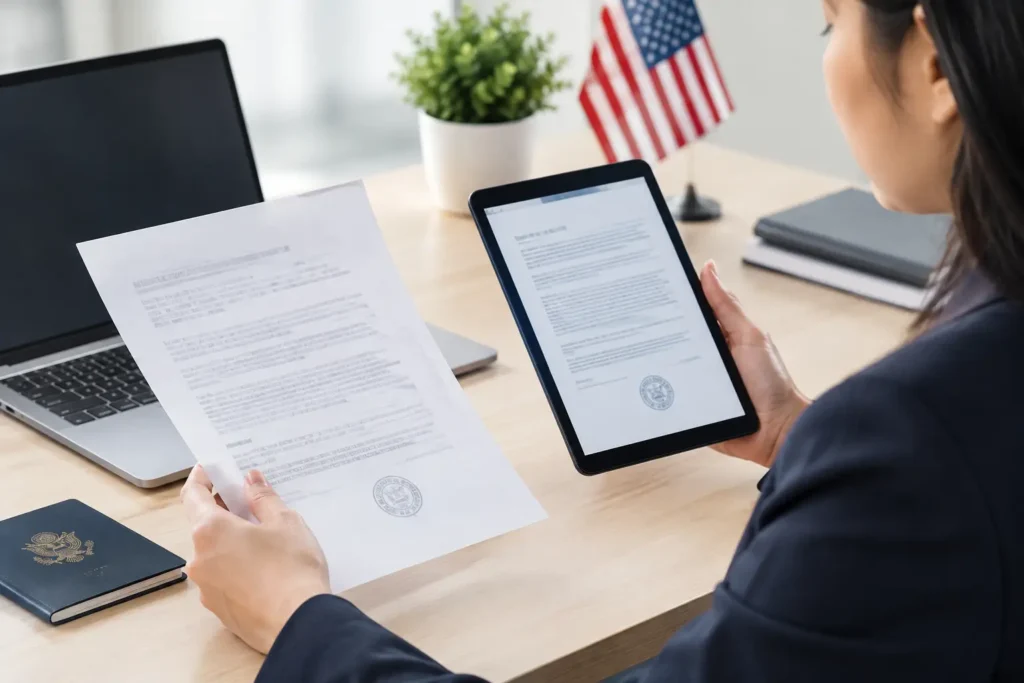
A clear scan of a birth certificate is often the first file an immigration applicant uploads to a USCIS account. The next question is just as urgent: does USCIS accept digital translations? In many cases, yes. USCIS generally allows applicants to submit documents electronically, including translated documents, as long as the translation meets its content and certification requirements.
The format alone is not what makes a translation acceptable. A PDF delivered by email, a scanned signed certification, or an electronically prepared translation can all be appropriate for a filing. What matters is whether the translation is complete, accurate, readable, and accompanied by the required certification from a qualified translator.
Does USCIS Accept Digital Translations for Online Filings?
USCIS accepts digital document uploads for many online applications and petitions. If you are filing through a USCIS online account, you may upload a digital copy of the foreign-language document along with its full English translation and certification. For paper filings, applicants commonly include printed copies of the translated document and certification with the application package.
USCIS generally accepts copies of supporting documents unless it specifically requests an original. That means a high-quality scan of the original record and a professionally prepared English translation are usually suitable at the initial filing stage. However, USCIS can later request originals, clearer copies, or additional evidence through a Request for Evidence (RFE).
A digital submission should be easy for an officer to review. Blurry phone photos, cut-off seals, unreadable handwriting, and files with missing pages can create avoidable delays. The translation should identify the document clearly and follow the same order as the source document so the officer can compare the two records without confusion.
What USCIS Requires From a Translation
USCIS requires a full English translation of every foreign-language document submitted in support of an immigration benefit request. The translator must certify that the translation is complete and accurate and that they are competent to translate from the foreign language into English.
A proper USCIS translation package normally includes the foreign-language document, the complete English translation, and the translator’s certification. The certification should include the translator’s name, signature, date, contact information, and a statement confirming accuracy and language competence.
The certification is not a minor formality. It is the statement that gives USCIS confidence that the English version represents the source document faithfully. A translation that summarizes a document, omits stamps or handwritten notes, or leaves out a back page may not satisfy USCIS requirements, even if the main text appears correct.
Complete Means More Than the Main Text
Official records often contain details that look unimportant at first glance: registry stamps, marginal notes, seals, annotations, handwritten corrections, and issuing-authority information. These details can matter in immigration review, particularly when USCIS is evaluating identity, parentage, marital history, education, or prior immigration records.
A complete translation should account for all relevant text on the document. When a seal or stamp cannot be read, a professional translator may indicate that it is illegible rather than guessing. Accuracy includes knowing when not to make assumptions.
Digital File vs. Machine Translation
The word “digital” can describe two very different things. A translation may be digitally delivered by a human professional, or it may be generated by automated translation software. These are not equivalent for USCIS purposes.
A human translator can review names, dates, legal terminology, handwritten entries, regional document formats, and context. They can also provide the required certification of accuracy and competence. An automated tool cannot reliably certify itself as a qualified translator, and its output may mishandle personal names, civil-status terms, court language, or abbreviations.
For example, a phrase on a civil record may have a specific legal meaning in the issuing country that does not match its literal English equivalent. A machine-generated translation can sound fluent while still being legally misleading. Immigration documents should be translated by a qualified human translator who understands that every detail may be reviewed as evidence.
Are Electronic Signatures and Scanned Certifications Acceptable?
A signed translator certification is required, but the practical treatment of electronic signatures and scanned signatures can depend on the filing method, the specific USCIS form instructions, and the facts of the case. For online filings, applicants commonly upload a PDF that includes a signed certification page. For paper filings, a printed certification with the translation is typically included in the package.
A scanned signature on a certification is often used for digital submissions, but applicants should not assume that every agency, consulate, court, or attorney will have identical preferences. If USCIS requests an original document or an original certification, follow that request exactly and respond by the deadline.
The safest approach is to obtain a translation package that is prepared for both possibilities. Keep the original electronic PDF, retain any signed hard-copy certification when provided, and store the source documents in a secure place. This makes it easier to respond if USCIS asks for additional evidence later.
When a Notarized Translation May Be Needed
USCIS does not generally require translations to be notarized. USCIS requires certification by the translator, not notarization of the translation itself. Notarization and certification serve different purposes: the translator certification addresses translation accuracy, while notarization verifies the identity of the person signing a document.
Still, notarization may be requested by another organization involved in your process, such as a foreign consulate, court, university, licensing board, or employer. Some applicants also choose notarized translations for records that will be used across multiple official settings.
Before paying for notarization, check the instructions for the exact institution receiving the documents. Ordering unnecessary services can add time and cost. On the other hand, if the document will be used for both USCIS and a separate authority with notarization rules, planning for that requirement early can prevent a second translation order.
How to Prepare Digital Translations for USCIS
Start with a clear, complete scan or photograph of the original document. Capture every page, including reverse sides, stamps, attachments, and handwritten notes. Do not crop the document so tightly that seals or identifying details disappear.
Next, have the document translated in full by a qualified human translator. Ask for a USCIS-ready certification that states the translation is complete and accurate and confirms the translator’s competence in both languages. The translated text should be formatted clearly, with page labels or document identifiers that help match it to the source.
Before uploading or mailing the package, review the application instructions for the form you are filing. Confirm the accepted file types and size limits for online submissions. If filing by mail, print the documents clearly and organize them so the foreign-language record, English translation, and certification stay together.
A final quality check can prevent common filing issues. Make sure names, dates, document numbers, and places of birth are rendered consistently across your application and supporting evidence. If a name appears in different spellings because of transliteration, address that discrepancy appropriately in the application rather than altering the translated record.
Documents That Need Extra Care
Some records carry higher risk because small translation errors can affect eligibility or create apparent inconsistencies. These commonly include birth certificates, marriage and divorce records, passports, police certificates, court dispositions, medical reports, academic transcripts, and prior immigration documents.
Court records deserve particular attention. A single word can change the description of an offense, the result of a proceeding, or the conditions of a sentence. Medical and psychological records also require careful handling because they combine technical terminology with highly sensitive personal information. In these cases, confidentiality and subject-matter expertise are as essential as certification.
AL Waseem Translation prepares human-translated, certified document packages for USCIS and other official uses, with attention to the source document, required certification, and secure handling of personal records.
Avoid Delays Caused by Translation Errors
USCIS may issue an RFE when submitted evidence is incomplete, unclear, or inconsistent. While an RFE does not automatically mean a case will be denied, it can add weeks or months to the process. A missing certification, partial translation, or unreadable upload is a problem that can often be avoided before filing.
Do not edit a translation yourself to make it match a preferred spelling or application answer. If there is a genuine discrepancy in the underlying records, preserve the document accurately and seek appropriate legal guidance about how to explain it. The role of the translation is to faithfully represent the original, not to correct or reinterpret it.
A digital translation can be fully suitable for USCIS when it is complete, professionally prepared, properly certified, and submitted in a readable format. Treat it as immigration evidence, not ordinary paperwork. Careful preparation now gives your application a stronger, clearer record when it reaches USCIS.