
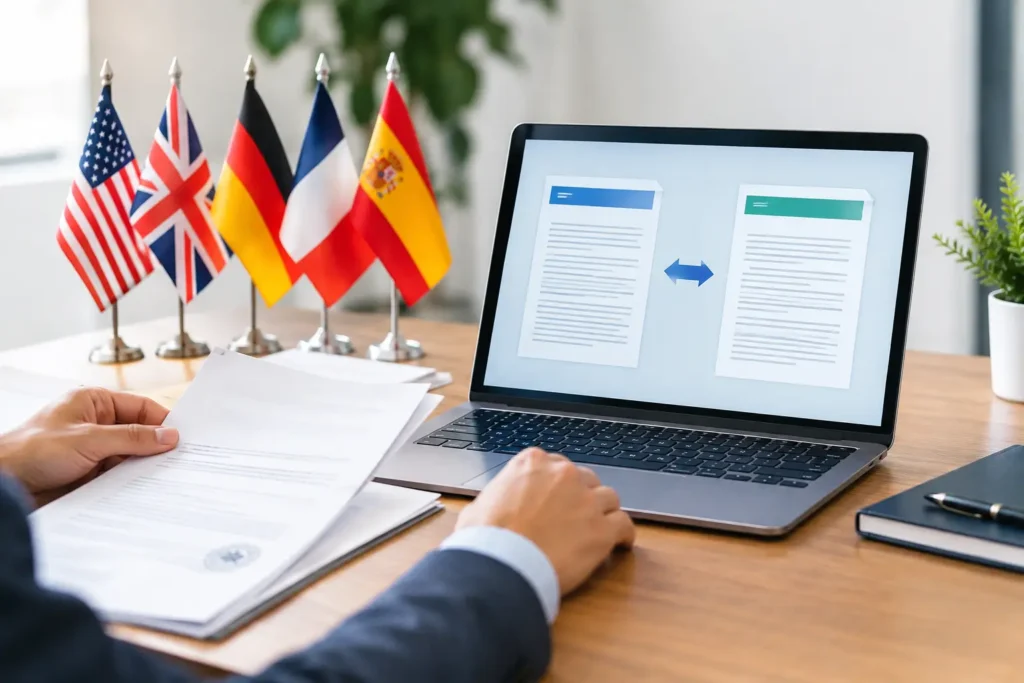
A birth certificate translated in seconds may look complete. But if a parent’s name is rendered incorrectly, a stamp is omitted, or a handwritten note changes the meaning of a date, that document can create delays with USCIS, a court, a university, or a medical provider. Machine translation is useful in many settings, but official documents demand a higher standard of accuracy, context, and accountability.
For individuals handling immigration, legal, medical, or academic paperwork, the real question is not whether a tool can translate words. It is whether the final document will be clear, complete, and acceptable to the institution receiving it.
What Is Machine Translation?
Machine translation is the automated conversion of text from one language to another using software, artificial intelligence, or statistical language models. It can translate website content, messages, product descriptions, and simple instructions at remarkable speed. For everyday communication, it can be a practical starting point.
Its limitations become more visible when language carries legal, clinical, or procedural consequences. Translation systems work from patterns in data. They do not independently verify facts, inspect a document’s purpose, confirm whether a seal is legible, or take responsibility for the final result. They may also struggle with poor scans, regional wording, abbreviations, handwritten entries, and terminology that has more than one meaning.
That does not make automated translation useless. It means the right method depends on what is being translated and what is at stake.
When Machine Translation Can Be Helpful
For low-risk material, machine translation can save time. A traveler may use it to understand a restaurant menu. A business team may use it to get the general meaning of an informal email from an overseas supplier. A researcher may use it to identify whether a foreign-language article is relevant before arranging a full translation.
It can also support professional workflows when used carefully. A qualified translator may use technology for terminology consistency, formatting support, or initial reference, then thoroughly review and revise the content. In that process, the trained human professional remains responsible for accuracy, completeness, and appropriate wording.
The distinction matters. A raw automated output is not the same as a human-reviewed translation. For official use, that difference can determine whether a document moves forward or is returned for correction.
Why Official Documents Need Human Translation
Official documents are not simply collections of words. They are records with names, dates, legal status, medical facts, institutional seals, and formatting that may all affect how the document is understood.
Consider a marriage certificate. In one country, a term may refer to a civil registry office; in another context, it may describe the official who issued the record. An automated system may choose a common but inaccurate equivalent. Similarly, a medical report may contain abbreviations that have different meanings depending on specialty or country. A legal document may use a phrase that cannot be translated word for word without changing its legal effect.
Human translators evaluate the document as a whole. They recognize when a literal translation would confuse the reader, preserve the meaning of stamps and seals, identify unclear source text, and use terminology appropriate to the receiving institution. When required, they can also provide a signed certification statement attesting that the translation is complete and accurate to the best of their knowledge and ability.
For immigration filings, certified translations are commonly required for documents that are not in English. USCIS requires a complete English translation accompanied by a certification from the translator stating that the translation is complete and accurate and that the translator is competent to translate from the foreign language into English. A machine-generated output alone does not provide that professional certification or the accountability behind it.
Common Risks of Using Raw Machine Translation
The most obvious risk is mistranslation, but official-document errors often go beyond a single wrong word. Automated systems can omit text in difficult layouts, misread scanned characters, fail to reproduce information from seals or marginal notes, or rearrange content in ways that make comparison difficult.
Names present another concern. A system may attempt to translate, alter, or inconsistently transliterate a name that must match a passport, visa, court filing, or previous record. Dates can also cause problems when source documents use a different calendar system or date order. What appears to be a minor formatting issue can create a mismatch across an immigration application or employment file.
Privacy is equally important. Uploading passports, medical histories, financial statements, or legal records to a public online tool may expose sensitive personal information to terms and data practices the user has not reviewed. Individuals and organizations should know how their documents are stored, handled, and protected before sharing them.
Finally, automated output may lack the certification, notarization, or formatting required by a particular agency. Notarization does not verify the accuracy of the translation itself. Instead, it generally verifies the identity of the person signing a statement. Whether notarization is needed depends on the receiving authority’s rules, so it should not be added or skipped based on assumption.
Choosing the Right Translation Method
The appropriate approach depends on the document’s purpose. For an informal message where a general understanding is enough, machine translation may be perfectly reasonable. For a document that affects immigration status, legal rights, healthcare, admission, employment, finances, or international transactions, professional human translation is the safer choice.
Before ordering a translation, confirm what the receiving organization requires. Ask whether it needs a certified translation, notarization, a particular layout, copies of seals and stamps, or an accompanying affidavit. Courts, embassies, universities, state agencies, and employers may have different standards. A translation that is accurate but prepared in the wrong format can still cause unnecessary delay.
It is also wise to provide a clear, complete scan of every page, including blank pages when they contain stamps, endorsements, or identifying information. Do not crop seals, signatures, handwritten notes, or document numbers. If a name appears differently across records, share that information with the translation provider so potential inconsistencies can be handled carefully rather than discovered later.
Machine Translation and Human Expertise Work Differently
Speed is the strongest advantage of machine translation. Human expertise is the stronger safeguard when precision matters. These are not always competing options, but they should not be treated as interchangeable.
A professional translation provider can assign a translator with relevant subject-matter knowledge, whether the document involves family law, medical treatment, academic credentials, corporate records, or immigration evidence. That translator can account for terminology, document conventions, and the expectations of English-speaking readers. Quality review adds another layer of protection before the document is delivered.
For high-stakes paperwork, the goal is not merely to produce English text. The goal is to produce a reliable English-language document that faithfully represents the original and is ready for its intended use. That requires judgment, confidentiality, and a person who can stand behind the work.
AL Waseem Translation provides human-only translation services for documents that need to be prepared for official use, including certified translations for immigration, legal, medical, academic, and personal records. When timing is tight, choosing the correct service at the start can help prevent resubmissions and avoidable setbacks.
A Practical Standard for Sensitive Documents
If an error would be inconvenient, review the machine output carefully. If an error could affect a filing, case, treatment decision, credential evaluation, or legal outcome, use a qualified human translator and request the documentation required by the recipient.
Translation should make an important document understandable without making it less trustworthy. For paperwork that carries real consequences, accuracy is not a feature to add later. It is the foundation that lets the next step happen with confidence.