
A missed word during an immigration interview, informed-consent discussion, or court proceeding can change what happens next. That is why remote interpreting industry trends matter far beyond technology. They affect whether people receive clear information, whether institutions meet language-access obligations, and whether critical conversations can proceed without delay.
Remote interpreting has moved from an emergency alternative to a core service model for hospitals, law firms, government agencies, schools, and businesses. Video and telephone options can connect qualified interpreters with people who need support quickly, including in rural areas and outside standard business hours. But speed alone is not enough. The strongest trend in the industry is a higher standard for accuracy, privacy, qualifications, and documentation.
Remote Interpreting Industry Trends Are Raising the Standard
Organizations once treated remote interpretation primarily as a way to reduce travel time and scheduling challenges. Those benefits remain significant, but clients now expect more. They want the same professional care they would expect from an in-person interpreter, with clear procedures for confidential and high-stakes conversations.
This shift is especially visible in legal and medical settings. A bilingual staff member may be helpful in casual situations, but they are not automatically qualified to interpret medical terminology, legal instructions, testimony, or informed consent. Professional interpreters understand that they must convey meaning faithfully, preserve tone where relevant, and remain impartial.
For clients, this means remote interpreting should be selected based on the nature of the appointment, not simply on the fastest available connection. A short telephone call may be appropriate for scheduling or general intake. A video session may be the better choice when body language, documents, visual demonstrations, or multiple participants are involved.
Video Remote Interpreting Continues to Expand
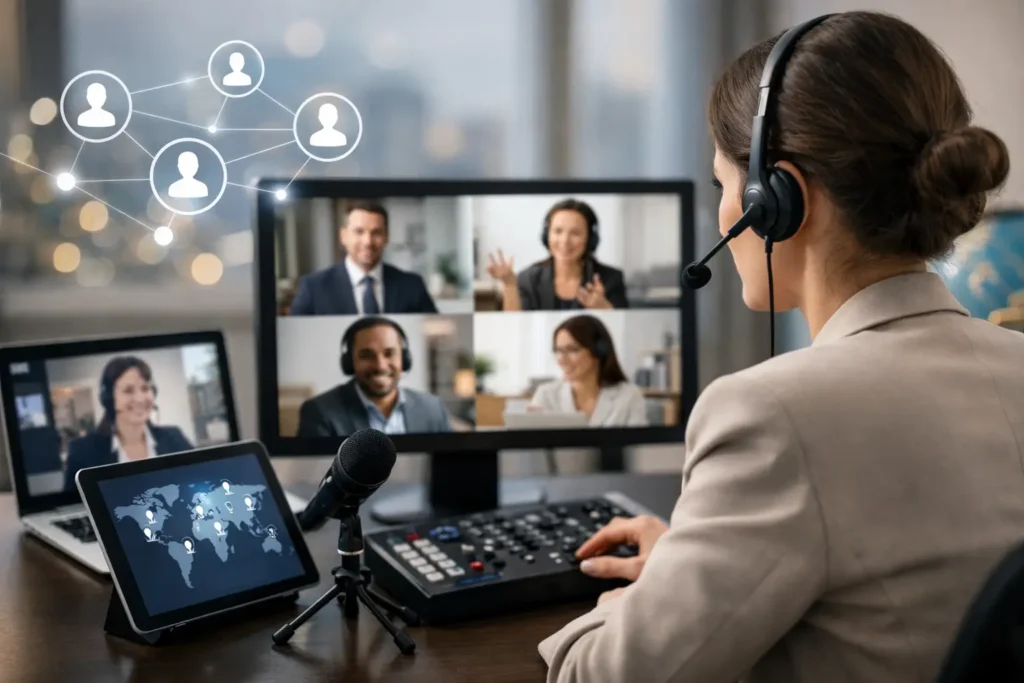
Video remote interpreting, often called VRI, is becoming a preferred choice for interactions where visual context improves communication. In healthcare, a provider may need to show a patient how to use medication or point to the area being discussed. During a legal consultation, an attorney may need to review documents with a client while ensuring every question and answer is understood.
Video is not automatically the right answer for every situation. It depends on internet reliability, the availability of a private location, the comfort level of the limited-English-proficient speaker, and whether the platform is suitable for confidential information. A poor connection can cause delays, missed details, and frustration at the exact moment clarity is most needed.
Organizations are responding by building better contingency plans. If video quality drops, the interpreter, provider, and client should know whether to switch to a secure telephone connection, reschedule, or bring in another qualified professional. Preparation prevents a technical issue from becoming a communication failure.
Telephone Interpreting Remains Essential
Telephone interpreting remains one of the most practical options for urgent and straightforward needs. It is often valuable when a client is traveling, a hospital needs rapid language support, or a business must communicate with a caller in a less common language.
Because telephone sessions do not provide visual cues, the interpreter must manage turn-taking carefully. Speakers should pause after short, complete thoughts and avoid talking over one another. The professional leading the conversation should identify everyone present and speak directly to the client, rather than saying, “Ask her” or “Tell him.”
This format is efficient, but it is less suitable when visual documents, emotional cues, or complex physical instructions are central to the conversation. Selecting the format deliberately is part of responsible language access.
Demand Is Growing for Specialized Interpreters
Another defining trend is greater demand for subject-matter expertise. An interpreter who is highly capable in a business meeting may not be the right fit for a medical diagnosis, deposition, asylum interview, or family court matter. Specialized assignments require familiarity with terminology, procedures, and professional boundaries.
In healthcare, accuracy supports informed consent, treatment adherence, and patient safety. In legal matters, an interpreter may need to handle terminology related to evidence, hearings, immigration records, contracts, or sworn statements. In business settings, the conversation may involve financial, technical, or regulatory language that cannot be handled casually.
Clients should provide the purpose of the appointment in advance whenever possible. Helpful details include the language needed, date and time, expected duration, number of participants, format preference, and the general subject matter. This allows the language services provider to assign an interpreter whose experience fits the request.
Privacy and Security Are Now Central Requirements
Remote interpretation frequently involves personal health information, legal claims, immigration details, financial records, and other sensitive subjects. As a result, organizations are placing more emphasis on secure platforms, confidential environments, and clear internal policies.
The practical requirements are straightforward, even if implementation takes planning. Participants should join from private locations, use approved communication tools, and avoid placing calls on speakerphone in public areas. Interpreters should follow confidentiality obligations and should not record, save, or share information from an appointment unless an authorized process specifically requires it.
For hospitals, law firms, and government-facing organizations, platform selection should be reviewed alongside existing privacy and compliance procedures. The least expensive option may create greater risk if it lacks appropriate controls or produces unreliable audio. Cost matters, but so do the consequences of a misunderstood or improperly handled conversation.
Artificial Intelligence Is Changing Workflows, Not Replacing Judgment
AI tools are increasingly used to support scheduling, call routing, transcription review, terminology preparation, and workflow management. These tools can help organizations respond faster, especially when they handle high call volumes or need to coordinate language support across multiple locations.
However, automated translation and interpretation have limits. They may struggle with regional dialects, context, names, legal phrasing, medical terminology, emotional nuance, and speech that is unclear or interrupted. In a high-stakes setting, an incorrect interpretation can affect rights, care, safety, or official outcomes.
The emerging best practice is to use technology to support professional human interpreters rather than substitute for them where accuracy is essential. Human judgment remains necessary when the conversation requires clarification, cultural awareness, impartiality, and accountability.
On-Demand Service Is Being Balanced With Quality Control
Clients increasingly expect fast access to interpreters, particularly for urgent healthcare, legal, and customer-service needs. This has increased demand for on-demand remote services, but it has also made quality control more important. Quick access is valuable only when the interpreter is qualified for the language pair and assignment.
A reliable provider should have a clear process for confirming language needs, identifying specialized requests, protecting client information, and addressing technical problems. For scheduled appointments, advance booking often creates the best opportunity to match the assignment with the right interpreter. For urgent calls, clients should still communicate the setting and purpose as clearly as possible.
At AL Waseem Translation, this practical approach supports clients who need professional language assistance alongside certified translation, notarization, and other document-ready services. For many cases, interpretation is one part of a larger process involving records, filings, interviews, or official submissions.
What Clients Should Ask Before Booking Remote Interpretation
Before confirming a service, individuals and organizations should consider four practical questions:
- Is telephone or video interpretation more appropriate for this conversation?
- Does the assignment require legal, medical, immigration, technical, or business experience?
- Can every participant join from a private location with a stable connection?
- Is there a backup plan if the connection fails or the appointment runs longer than expected?
These questions are not administrative details. They help protect the quality of the conversation and reduce avoidable delays. A well-planned remote session can make language access more available without lowering the standard of care.
Remote interpretation will continue to grow because people need timely communication wherever they are. The most dependable services will be those that pair convenient access with qualified human professionals, secure procedures, and careful preparation for the conversation at hand.