
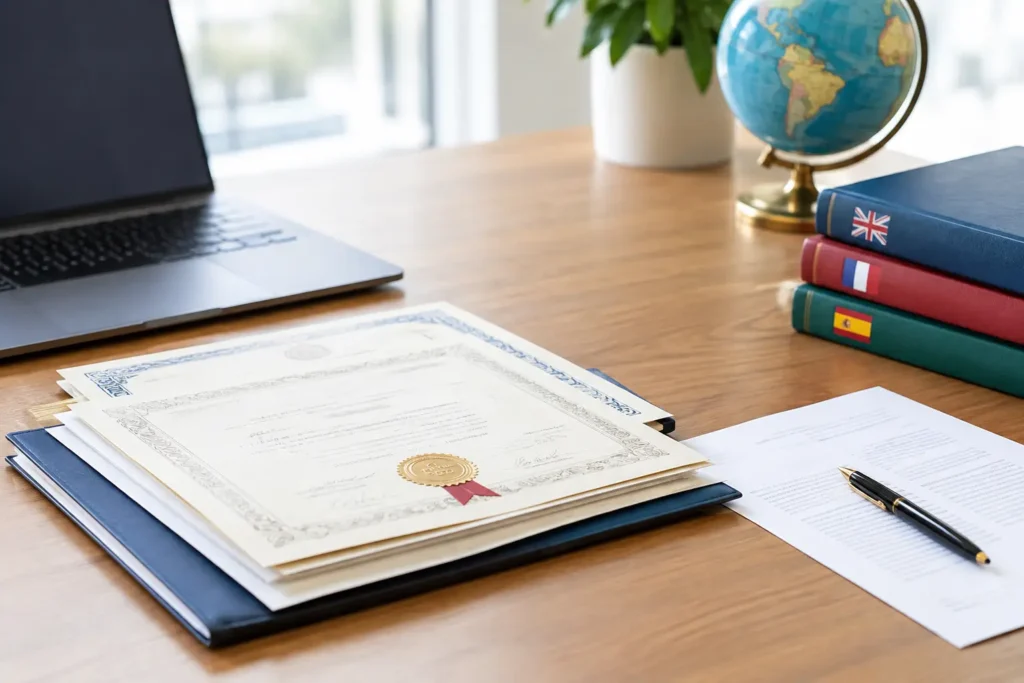
A diploma can represent years of study, professional preparation, and a major step toward your future in the United States. When you need to translate foreign diplomas for a university, employer, licensing board, or immigration application, the translation must do more than convert words from one language to another. It must accurately preserve the information institutions need to review your credentials.
A missing seal, an incorrectly rendered degree title, or a name that does not match your passport can delay an application. A professional certified translation helps present your academic record clearly, accurately, and in a format that is ready for official review.
Why Foreign Diploma Translation Requires Care
Diplomas often contain details that have no exact U.S. equivalent. The original document may use an academic title, grading system, ministry designation, faculty name, or credential level that requires careful treatment. The translator’s role is to faithfully translate what appears on the document, not to guess at an equivalent U.S. degree or improve the wording.
For example, a document may identify a qualification as a diploma, certificate, bachelor’s degree, specialist degree, or professional title. The appropriate English rendering depends on the source language, country, and educational context. This is why human translation by a linguist familiar with academic documents is safer than machine-generated output.
Schools and employers also need to see the document’s complete context. That includes stamps, seals, handwritten notations, signatures, issuing authorities, dates, and identification numbers when visible. Even text that cannot be read should be accounted for with a notation such as “illegible” or “seal.” Omitting those elements can create questions about whether the translation represents the full document.
When You Need to Translate Foreign Diplomas
The required format depends on where you are submitting your documents. Many U.S. colleges and universities request English translations of foreign diplomas and transcripts during admissions. Employers may request translated credentials to verify your education, especially for roles requiring a degree or specialized training.
Professional licensing boards may require translations for fields such as nursing, engineering, teaching, accounting, and healthcare. Immigration cases can also involve diplomas when academic history supports an application, although USCIS requirements vary by filing type and supporting evidence.
In most official situations, submit a translation together with a clear copy of the original-language diploma. Do not replace the original document with the translation. The reviewing institution needs both documents to compare the translated information with the source record.
What a Certified Diploma Translation Includes
A certified translation is accompanied by a signed statement from the translation provider or translator affirming that the translation is complete and accurate to the best of their knowledge and ability. Many U.S. institutions request this certification because it gives the translation a formal statement of accountability.
The certification should identify the language pair and confirm the translator’s competency. It should be attached to the translated document and source copy when the recipient requires a complete package. Some universities have their own instructions, so always review the admissions or credential-submission page before ordering.
A certified translation is not the same as a credential evaluation. Translation converts the content of your diploma into English. Credential evaluation assesses how a foreign academic qualification compares with U.S. educational standards. A school or licensing board may ask for one service, the other, or both. Ordering only a translation when an evaluation is required can cause an avoidable delay.
Information That Must Match Exactly
Names, dates, and document numbers deserve special attention. Your name on the diploma should be translated or transliterated consistently with the spelling used on your passport, immigration records, application, or other identity documents. If the spelling differs because of marriage, a legal name change, or a prior transliteration, provide the receiving institution with supporting documentation when appropriate.
The same standard applies to dates. A translator should accurately render dates while making the format understandable to a U.S. reader. For documents issued in calendars other than the Gregorian calendar, the translation may preserve the source date and include a clear conversion when required by the recipient.
Academic titles, institutions, departments, majors, and honors should also be translated with precision. A translator should not alter grades, convert marks to a U.S. GPA, or state that a credential is equivalent to an American degree unless a qualified credential evaluator has made that determination.
Should You Translate the Transcript Too?
In many cases, yes. A diploma confirms that you earned a credential, but a transcript provides the details behind it: coursework, credit hours, grades, academic terms, and sometimes the grading scale. Admissions offices, employers, and evaluators commonly need both documents to make a complete assessment.
If you are applying to a university or seeking professional licensing, review the recipient’s instructions closely. They may require translated transcripts to be sent directly by the issuing school, submitted in a sealed envelope, or delivered through a designated credential evaluation organization. A correct translation does not override those submission rules.
For a job application, the employer may only request a translated diploma. Still, keeping certified translations of both your diploma and transcript available can save time when another opportunity arises.
Do You Need Notarization or an Apostille?
Not every translated diploma needs notarization. Certification is the more common requirement for U.S. schools, employers, USCIS filings, and many agencies. Notarization may be requested when a particular recipient wants the translator’s certification statement signed before a notary public. It does not make the translation more accurate, but it can satisfy a specific procedural requirement.
An apostille serves a different purpose. It authenticates the signature or seal on a public document for use in another country that participates in the Hague Apostille Convention. It does not evaluate the academic content of a diploma and does not replace translation certification.
The right approach depends on the destination country and receiving organization. If you are submitting an academic document abroad, confirm whether an apostille must be obtained from the country where the original was issued, whether notarization is needed, and whether the translated version must be attached before apostille processing.
How to Prepare Your Diploma for Translation
Start with a high-quality scan or photograph of every page. All corners of the document should be visible, and stamps, embossed seals, signatures, and small-print text should be readable. If the diploma has information on the back, include that page as well.
Before placing an order, identify the receiving institution, deadline, required language, and whether certification or notarization is requested. Share those instructions with your translation provider. This prevents unnecessary formatting changes and helps ensure the final package matches the intended use.
A reliable provider should use qualified human translators, preserve the document layout where practical, handle personal information confidentially, and provide a signed certificate of translation accuracy when requested. AL Waseem Translation supports academic document translation in more than 150 languages, with certified options for clients who need institution-ready records on a deadline.
Common Mistakes That Cause Delays
Using an automated translation tool is one of the most common mistakes. Machine output can mistranslate degree names, overlook handwritten text, and fail to reproduce seals or formatting details. It also cannot provide a credible certification statement for official submission.
Another issue is submitting only part of the record. If a transcript, reverse side, annex, or explanatory page is attached to the diploma, ask whether it must be translated too. Institutions may reject incomplete documentation even when the translated page itself is accurate.
Finally, do not assume all recipients apply the same rules. A university may accept a certified translation from a professional provider, while a licensing authority may require an evaluation from a specific agency. Confirm requirements before paying for services, particularly when your filing deadline is close.
Submit a Translation That Supports Your Next Step
Your diploma is evidence of work you have already completed. A precise, certified English translation allows that achievement to be understood by the people making decisions about your education, career, immigration case, or professional license. Provide clear source documents, verify the recipient’s instructions, and choose a qualified human translation provider so your records are ready when the opportunity arrives.