
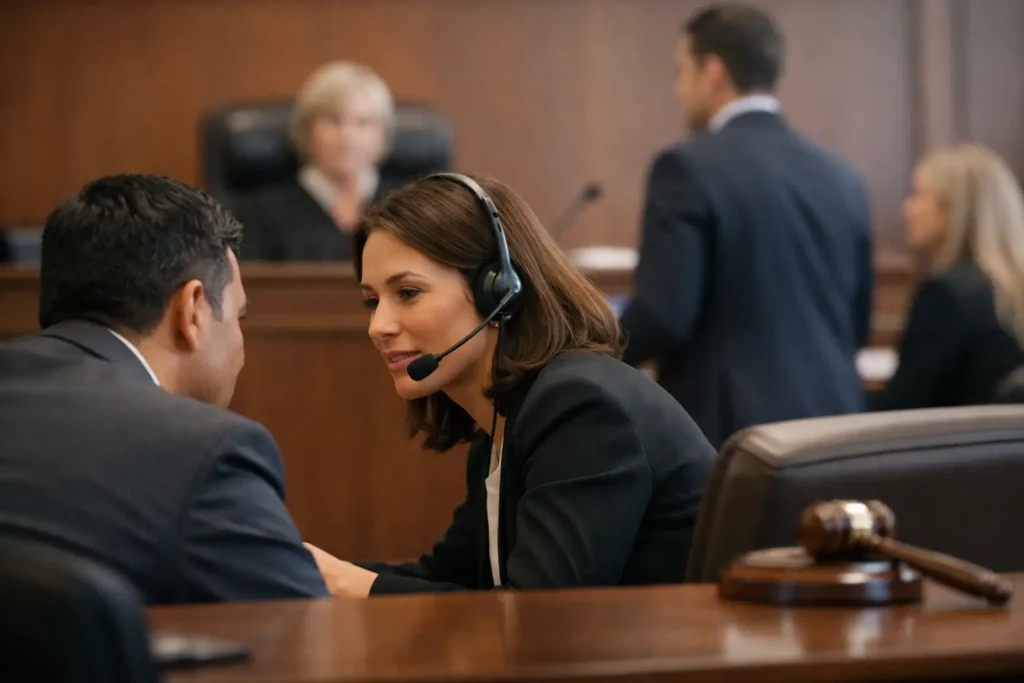
A missed word in a courtroom can change more than the tone of a conversation. It can affect a plea, a custody decision, a protection order, testimony, or a person’s ability to understand a judge’s instructions. Court interpreters make meaningful participation possible for people with limited English proficiency, but their role is often misunderstood.
An interpreter is not an advocate, legal advisor, or witness coach. The interpreter’s job is to accurately convey what is said from one language to another, preserving meaning, register, and intent as closely as possible. When the matter is high stakes, the quality and qualifications of that interpreter deserve careful attention.
Why Court Interpretation Matters
US courts have a responsibility to provide meaningful language access in many proceedings. The exact requirements vary by state, court type, case type, and the person’s role in the matter. Criminal cases commonly have the strongest constitutional protections, but interpretation may also be available or required in family, immigration, civil, probate, traffic, and administrative proceedings.
The practical purpose is simple: everyone must be able to understand the proceeding and communicate with the court. A defendant must understand charges and plea terms. A parent in a custody case must be able to follow testimony and respond to questions. A witness must be able to give an answer in the language they understand best without someone changing or simplifying it.
Language access is not a courtesy. It is closely connected to due process, fairness, and the reliability of the court record.
What Court Interpreters Actually Do
Court interpreters work in several modes, sometimes within the same hearing. The appropriate mode depends on what is happening in the courtroom.
Consecutive interpretation
In consecutive interpretation, the speaker pauses while the interpreter renders the message into the other language. This is commonly used for witness testimony, attorney-client exchanges in court, and direct questions from the judge. The interpreter may take notes to preserve details such as dates, names, quantities, and sequences of events.
Simultaneous interpretation
In simultaneous interpretation, the interpreter speaks while listening, typically in a quiet voice or through courtroom audio equipment. This is often used to interpret proceedings for a party who needs to follow everything being said in real time. It requires intense concentration and strong command of courtroom terminology.
Sight translation
Sight translation means orally rendering a written document into another language. A judge may ask for a document to be interpreted on the spot, such as a waiver, form, exhibit, or court order. Sight translation is not the same as a certified written translation. If a document must be filed, submitted to an agency, or retained as an official record, it may need a separate written translation prepared under the court’s or agency’s requirements.
A qualified interpreter must move between these modes without adding explanations, omitting difficult language, or giving personal opinions. If a word has no direct equivalent, the interpreter should communicate the closest accurate meaning, not substitute a legal conclusion.
Interpreter Qualifications Depend on the Court
Not every bilingual person is qualified to interpret in court. Fluency is only the starting point. Court interpretation requires advanced listening skills, memory, cultural awareness, professional ethics, and knowledge of legal procedure in both languages.
Many state court systems maintain credentialing programs for interpreters. These programs may involve written examinations, oral performance testing, ethics training, background screening, and continuing education. Federal courts have a separate certification process for certain languages, and certification is not available for every language.
For languages with no formal certification exam, courts may use terms such as registered, qualified, approved, or otherwise credentialed. The terminology matters less than the court’s actual standard and the interpreter’s demonstrated ability. A court-approved interpreter in one jurisdiction is not automatically approved in another.
When arranging services, ask whether the interpreter has experience in the relevant court setting and language pair. A skilled medical or business interpreter may still need specific court training before handling testimony, arraignments, depositions, or family-law hearings.
Accuracy Means More Than Word-for-Word Substitution
Good court interpretation is faithful, complete, and impartial. It does not mean mechanically replacing every English word with a word from another language. Languages use different grammar, levels of formality, and legal concepts. The interpreter must preserve the speaker’s meaning without making the message sound more educated, more certain, or more persuasive than it was.
For example, a witness who says, “I think it was around midnight,” should not be interpreted as, “It was midnight.” Likewise, slang, hesitation, emotion, and uncertainty can be meaningful. The interpreter should not clean up a speaker’s grammar or omit a phrase simply because it sounds repetitive.
Accuracy also includes preserving the limits of communication. If the interpreter cannot hear a speaker, does not understand a regional term, or needs repetition, the interpreter should ask the court for clarification. That is a professional safeguard, not a failure.
Confidentiality and Impartiality Are Nonnegotiable
Court interpreters are generally bound by ethics rules requiring confidentiality, accuracy, and impartiality. They should not discuss case details outside the professional setting or share information with family members, employers, or other parties without authorization.
They must also disclose conflicts of interest. An interpreter should not accept an assignment involving a close friend, family member, business partner, or personal dispute. Even if the interpreter believes they can remain neutral, the appearance of bias can undermine confidence in the proceeding.
Using a relative, friend, child, or untrained bilingual employee may seem convenient, especially for a short hearing. It can create serious problems. The person may summarize instead of interpret, lack legal vocabulary, feel pressured to protect one side, or be unable to remain confidential. Courts generally prefer qualified professionals for good reason.
How to Prepare for an Interpreted Court Hearing
Preparation helps interpreters perform accurately and helps the court avoid avoidable delays. Parties, attorneys, and organizations should identify language needs as early as possible. Do not wait until the morning of the hearing if language access can be requested in advance.
Provide the correct language and, where relevant, the dialect. “Chinese,” “Arabic,” or “Kurdish” may not be specific enough. A person may speak Mandarin, Cantonese, Egyptian Arabic, Iraqi Arabic, Sorani Kurdish, or Kurmanji Kurdish. The right match can affect comprehension and trust.
Attorneys and case coordinators should share appropriate case materials and specialized terminology in advance when court rules permit. Names, technical evidence, medical terms, business records, and unusual acronyms can require preparation. This does not mean coaching the interpreter on how to render testimony. It means allowing the interpreter to understand terminology before the hearing begins.
At the hearing, speak in manageable segments, avoid talking over others, and allow the interpreter to finish. Address the person directly rather than saying, “Ask her whether she saw the accident.” Say, “Did you see the accident?” The interpreter will handle the language conversion.
If the person receiving interpretation does not understand, they should tell the judge, attorney, or interpreter immediately. They should not guess at what was said or agree simply because the room feels rushed.
Remote Court Interpretation Requires Extra Planning
Video and telephone hearings can improve access, particularly when an in-person interpreter is unavailable for a less common language. They also introduce risks: weak audio, poor connections, overlapping speakers, limited privacy, and difficulty seeing documents or body language.
For remote proceedings, test the platform before the hearing and use a stable internet connection, quality headset, and private room. The interpreter should be able to hear all speakers clearly and have access to any documents that must be interpreted. If the connection makes accurate interpretation impossible, the issue should be raised promptly rather than ignored.
Remote interpretation can be effective, but it is not always the best choice. Complex testimony, emotionally sensitive family matters, lengthy evidentiary hearings, and proceedings involving multiple speakers may call for in-person support when available.
Written Translation and Interpretation Serve Different Needs
A court interpreter handles spoken communication during a proceeding. A translator prepares written documents, such as foreign-language records, exhibits, declarations, certificates, or correspondence. One professional may be qualified to provide both services, but the work products and requirements are different.
When a court requires a written translation, ask about certification language, formatting, notarization, filing deadlines, and whether the original document must be attached. For documents intended for court, USCIS, or other official use, human translation and a clear certification statement help support acceptance. AL Waseem Translation provides court-ready language services for clients who need professionally translated documents alongside interpretation support.
The best time to address language access is before the hearing date is close. Confirm the language, ask about the court’s credentialing requirements, prepare documents early, and speak up if communication is not clear. A qualified interpreter cannot decide the case, but they can ensure that language is not what prevents someone from being heard.