
A missed word during a court hearing, medical appointment, or immigration interview can change far more than the conversation. It can affect a legal record, a treatment decision, or the outcome of an application. That is why people often ask, what is certified interpretation, and whether they need it for an official appointment.
Certified interpretation is spoken-language interpretation delivered by an interpreter who has earned a recognized credential, met a specific qualification standard, or been approved by the organization requesting the service. The exact meaning of “certified” depends on the setting. A court may require a state-certified court interpreter, while a hospital may require a qualified medical interpreter with demonstrated language proficiency and training.
The practical goal remains the same: accurate, impartial communication between people who do not share a language, with an interpreter whose skills can stand up to the demands of the situation.
What Is Certified Interpretation in Practice?
Interpretation happens in real time. One person speaks, the interpreter conveys the meaning in the other language, and the conversation continues. Unlike document translation, which deals with written text, interpretation requires the professional to listen, process meaning, and communicate clearly under time pressure.
A certified interpreter has usually completed testing or formal evaluation in language proficiency, interpreting techniques, ethics, and subject-specific terminology. In some fields, certification is issued by a government agency, court system, professional organization, or recognized credentialing body. In other settings, the requesting institution sets its own standards for who is considered qualified.
This distinction matters because there is no single national certificate that applies to every language, every state, and every type of appointment. Spanish court interpretation may have a well-defined state certification pathway, for example, while certification may not be available for a less commonly requested language. In that case, a court or agency may approve a highly qualified interpreter based on testing, experience, and demonstrated competence.
“Certified” should never be treated as a generic marketing label. Before booking, ask what credential or approval the court, hospital, attorney, school, employer, or government agency requires. The right answer depends on where the interpretation will be used.
Certified Interpretation vs. Certified Translation
These services are related, but they are not interchangeable.
Certified translation applies to written documents, such as birth certificates, passports, diplomas, medical reports, contracts, and immigration records. The translated document is accompanied by a signed certification statement confirming that the translation is complete and accurate to the best of the translator’s knowledge and ability.
Certified interpretation applies to spoken communication. The interpreter may hold a professional credential or meet an institution’s qualification requirements, but they do not produce a written certification for every conversation in the same way a document translator certifies a translation.
An interpreter may, however, be asked to sign an oath, affirmation, attendance record, or declaration. This is common in court proceedings, depositions, notarization appointments, and other formal settings. The purpose is to confirm impartiality, accuracy, confidentiality, or the interpreter’s role during the event.
If you need to submit a foreign-language document to USCIS, a court, university, or consulate, you generally need certified translation. If you need help communicating during an interview, hearing, appointment, or meeting, you need interpretation. Some cases require both.
When Is a Certified Interpreter Needed?
A certified or formally qualified interpreter is most valuable when the consequences of misunderstanding are serious. Legal, medical, immigration, and government-facing situations often involve deadlines, rights, financial obligations, or personal safety.
Court hearings and legal proceedings
Courts must protect each party’s ability to understand the proceeding and participate meaningfully. A court-certified interpreter is often required for hearings, trials, arraignments, depositions, attorney-client meetings, and related legal matters. Court interpreters must accurately convey testimony, legal instructions, objections, and questions without adding explanations or personal opinions.
Legal interpretation also demands confidentiality and neutrality. A bilingual friend or family member may understand both languages, but they are not a substitute for an impartial professional in a high-stakes legal setting.
Medical appointments and healthcare discussions
Medical interpretation supports communication between patients, family members, physicians, nurses, specialists, and administrative staff. It may be needed during diagnosis, consent discussions, treatment planning, discharge instructions, mental health appointments, or emergency care.
Medical terminology is only one part of the job. The interpreter must communicate the speaker’s meaning faithfully, preserve tone, avoid omissions, and recognize the boundaries of the role. They are not there to diagnose, explain treatment independently, or make decisions for the patient.
Immigration, consular, and government appointments
Applicants may need an interpreter for certain immigration consultations, attorney meetings, interviews, or appointments involving foreign government offices. Requirements vary by agency and appointment type. Some offices provide an interpreter, some permit one, and some restrict who may interpret.
Before relying on an interpreter, confirm the agency’s rules. An interpreter who is appropriate for a private attorney consultation may not meet the requirements for a formal government interview.
Business, education, and personal matters
Certified interpretation can also be necessary for contract negotiations, HR investigations, academic meetings, insurance discussions, social services appointments, and notarization sessions. Here, the organization may not require a government-issued certificate, but it may require an experienced professional who can handle specialized vocabulary and protect confidential information.
The Main Types of Interpretation
The format should fit the appointment, the number of participants, the language pair, and the level of confidentiality required.
Consecutive interpretation is common in appointments, interviews, depositions, and medical consultations. The speaker pauses after a short section, then the interpreter conveys the message in the other language. It allows for careful communication and is well suited to smaller conversations.
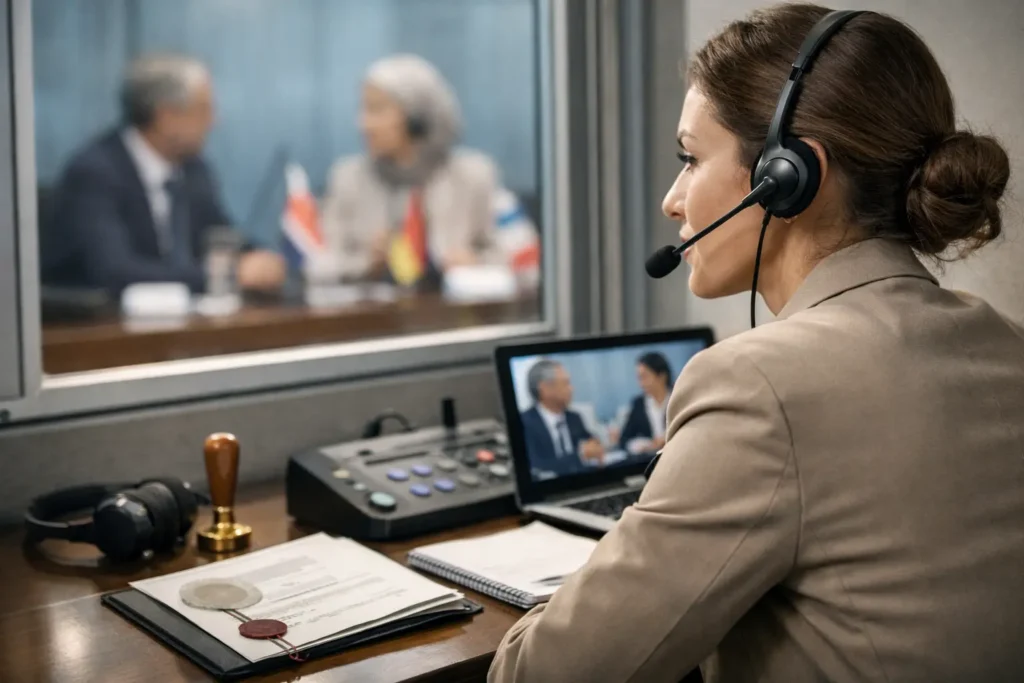
Simultaneous interpretation occurs while the speaker is still talking. It is often used for conferences, large meetings, court proceedings, and events where participants need to hear the interpretation immediately. This format usually requires specialized equipment and, for longer assignments, a team of interpreters.
Over-the-phone interpretation provides quick access when an in-person interpreter is not available or when the conversation is brief. It can be useful for scheduling, customer support, triage, and routine conversations, though it may be less effective when documents, visual cues, or sensitive legal issues are involved.
Video remote interpretation combines live spoken interpretation with visual access through a secure video platform. It can be an efficient option for remote meetings and time-sensitive appointments, provided the connection, audio, privacy, and platform requirements are appropriate.
What to Expect From a Qualified Interpreter
A professional interpreter does more than speak two languages. They follow recognized standards of conduct designed to protect everyone involved in the conversation.
First, the interpreter should interpret accurately and completely. That means conveying what is said without summarizing, softening, changing, or leaving out information. If a speaker uses unclear language, the interpreter should ask for clarification rather than guess.
Second, the interpreter should remain impartial. They should not advise either party, advocate for an outcome, answer questions on someone’s behalf, or inject personal views into the conversation. Their role is communication, not representation.
Third, confidentiality is essential. Sensitive health information, legal strategy, immigration history, financial information, and family matters should be handled with appropriate discretion. For formal appointments, it is reasonable to ask how confidentiality is protected and whether the interpreter is bound by professional ethics or a confidentiality agreement.
Finally, a qualified interpreter understands when specialized knowledge is necessary. A routine customer-service call and a medical consent conference should not be assigned using the same criteria. The more technical or consequential the setting, the more important it is to select an interpreter with relevant training and experience.
How to Request the Right Service
When arranging interpretation, provide as much information as possible upfront. The language and dialect, date, time, location or video platform, estimated duration, and purpose of the appointment all affect scheduling. Let the provider know whether the matter involves court, healthcare, immigration, business, or another specialized field.
You should also identify any institution-specific requirements. If a court requires a state-certified interpreter, say so at the start. If the assignment involves a deposition, a medical procedure, a notarization, or a confidential corporate meeting, that information helps ensure the interpreter is appropriately matched.
Do not assume that a bilingual employee, relative, or friend can fulfill a formal requirement. They may be helpful in everyday situations, but official settings often require independence, documented qualifications, and professional ethics. Using the wrong person can lead to delays, a rescheduled appointment, or questions about whether the communication was reliable.
AL Waseem Translation helps individuals and organizations arrange professional interpretation across more than 150 languages for legal, medical, immigration, business, and personal matters. For appointments with strict requirements, the best first step is to confirm the requesting institution’s standards, then reserve an interpreter whose qualifications match the situation.