
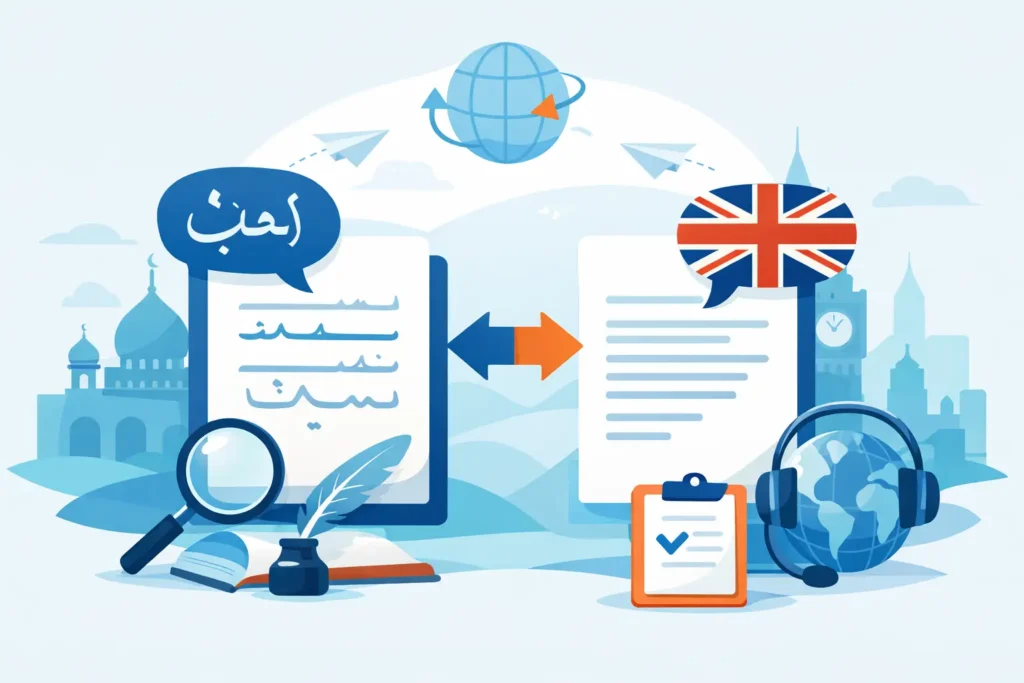
Arabic to English Certified Translation
A birth certificate rejected by USCIS, a diploma delayed by a university, or a court filing sent back for correction usually comes down to one issue – the Arabic to English certified translation was not prepared the way the receiving authority expected. When a document affects immigration status, legal rights, education, or medical care, translation is not just about language. It is about acceptance.
Arabic documents often carry formatting, terminology, and naming conventions that require more than general fluency. A certified translation must present the content accurately, completely, and in a form that institutions in the United States can review with confidence. That is why the difference between a casual translation and a certified one matters so much.
Order Translation Instantly.
What Arabic-to-English certified translation actually means
A certified translation is a complete translation accompanied by a signed statement from the translator or translation company confirming that the translation is accurate and complete to the best of their knowledge and ability. In the US, this certification is commonly required for official use, especially when the source document is in Arabic and the receiving institution operates in English.
This does not always mean the translation is notarized, and it does not always mean a court-sworn translator is required. The exact requirement depends on where the document is being submitted. USCIS, universities, courts, employers, licensing boards, and foreign consulates may each ask for slightly different supporting steps. Some will accept certification alone. Others may request notarization or additional authentication.
That is where many people get stuck. They assume any bilingual person can translate the document, attach a short note, and the file will be accepted. In practice, institutions are looking for a translation that is complete, readable, professionally formatted, and supported by proper certification.
When certified Arabic translations are usually required
Arabic to English certified translation is commonly needed for immigration filings, visa applications, passport matters, marriage registration, divorce proceedings, academic admissions, employment verification, and court submissions. Medical records, police clearances, bank statements, powers of attorney, and corporate records may also need certification when presented to an English-speaking authority.
For individuals, the most common documents include birth certificates, marriage certificates, divorce decrees, family books, academic transcripts, diplomas, and national ID documents. For businesses and institutions, the need often centers on contracts, incorporation papers, regulatory records, technical materials, and evidentiary documents.
The stakes are different in each case. A mistranslated personal name on an immigration file can trigger delays. An incomplete translation of a legal clause can create confusion in court. A poorly handled medical record can affect continuity of care. Certified translation exists to reduce those risks and produce a document ready for official review.
Why Arabic documents require special care
Arabic is not one uniform document environment. A translator may be working with records issued in Egypt, Saudi Arabia, the United Arab Emirates, Jordan, Iraq, Morocco, or another Arabic-speaking country, and each authority may use different document layouts, stamps, terminology, and administrative phrasing.
Names are one of the biggest trouble spots. Arabic naming structures do not always map neatly into English forms used by US institutions. A translator must preserve the source accurately while paying attention to consistency with passports, green cards, prior visa records, school files, or court documents. Even small differences in spelling can create questions if supporting documents do not match.
Dates are another issue. Some Arabic documents use different date formats or include Hijri dates alongside Gregorian dates. Official stamps, handwritten notes, marginal remarks, and seals also need to be handled carefully. A certified translation should reflect what appears on the document, not just the typed body text.
What a high-quality certified translation should include
A reliable Arabic-to-English certified translation should be complete. That means every visible element relevant to the document is translated or accounted for, including headers, stamps, seals, signatures, handwritten annotations, and official remarks when legible.
It should also be formatted in a way that mirrors the source document enough to make review easy. The goal is not graphic design. The goal is clarity. If the original contains boxes, registration numbers, issuing authority details, or official endorsements, the English version should present that information in a structured and understandable way.
Most importantly, the translation should be prepared by a qualified human translator with experience in official documents. This is not the place for guesswork, machine output, or loosely edited text. In legal, immigration, and institutional contexts, accuracy is the product.
Certified, notarized, sworn, and apostilled – what is the difference?
These terms are often used together, but they are not interchangeable. Certified translation refers to the accuracy statement attached to the translation. Notarized translation usually means the translator or company representative signed the certification before a notary. The notary verifies identity, not translation quality.
Sworn translation is a specific legal status in some countries where translators are officially authorized by a court or government body. In the US, certified translation is the more common standard for domestic submissions. An apostille is different again. It authenticates the origin of a public document for international use under the Hague Apostille Convention.
Whether you need one, two, or all of these depends entirely on the destination. A USCIS filing may require a certified translation but not an apostille. A foreign consulate may ask for translation plus notarization. A document headed overseas may need translation and apostille support as part of the same workflow.
How to choose the right provider
The safest choice is a company that regularly handles official Arabic documents for US institutions. Look for human-only translation, subject-matter expertise, clear certification practices, confidentiality, and a process for time-sensitive orders. If the provider cannot explain how they handle names, stamps, handwritten content, and institution-specific requirements, that is a warning sign.
Turnaround time matters, but speed should not come at the expense of review. Fast service is valuable when a deadline is approaching, yet quality control is what protects you from rejection and resubmission. A dependable provider will be clear about what can be delivered quickly and what may need more time because of complexity or document volume.
It also helps to work with a team that can support adjacent needs, such as notarization, apostille processing, interpretation, or transcription. If your matter involves multiple agencies, having one provider manage the document path can reduce errors and save time. AL Waseem Translation serves many clients in exactly these high-stakes situations.
Common mistakes that cause delays
One frequent mistake is submitting a partial translation. If only the main text is translated but the stamp, seal, side note, or issuing authority detail is ignored, the receiving institution may treat the file as incomplete.
Another problem is the inconsistent transliteration of names. If one document says Mohamed, another says Mohammad, and another says Muhammed, the inconsistency may require explanation or correction. A professional translator should flag these issues early and maintain consistency where appropriate.
People also run into trouble by assuming certification rules are the same everywhere. They are not. A university registrar may have one standard, while a court clerk or embassy applies another. Asking what the receiving authority requires before ordering can prevent unnecessary expense and delay.
What to prepare before ordering
Clear scans make a real difference. If the Arabic text is blurred, cropped, shadowed, or incomplete, the translator may not be able to certify the final text with confidence. Submit full-page scans in high resolution, including front and back when both sides contain content.
You should also provide context. Say where the document is going, whether the spelling of names must match an existing passport or immigration record, and whether notarization or apostille may be needed. That information helps the translation team prepare a version aligned with the actual use case rather than a generic output.
If the document contains handwritten text or uncommon regional terminology, mention that upfront. It can affect both timing and review requirements.
Why acceptance matters more than low price
For routine personal use, people sometimes shop for the cheapest translation they can find. For official use, that approach often costs more in the long run. A rejected translation can lead to missed deadlines, duplicate filing fees, postponed interviews, or legal inconvenience.
The better standard is document readiness. A certified translation should be prepared to stand up to institutional review the first time. That means accuracy, completeness, proper certification, and formatting that make the source document easy to evaluate. When your records affect immigration, education, court matters, or healthcare, acceptance is the result that matters.
If you are ordering an Arabic-to-English certified translation, think beyond converting words on a page. You are preparing evidence, identity, and official records for decision-makers who need clarity. The right translation does not draw attention to itself. It lets your document move forward.