
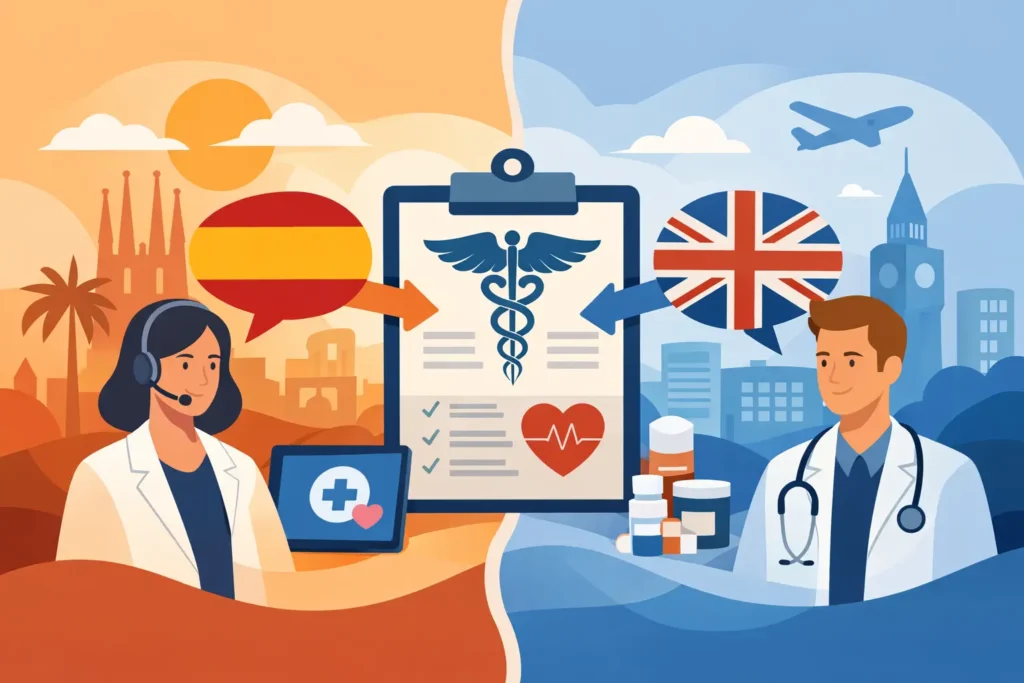
Spanish to English Medical Translation
A mistranslated dosage, diagnosis, or discharge note is not a small typo. In Spanish-to-English medical translation, one wrong term can delay care, confuse a provider, or create problems for insurance, immigration, legal review, or hospital intake. When medical documents matter, accuracy is not just about language. It is about patient safety, compliance, and making sure the record says exactly what the original says.
Medical translation from Spanish into English often involves more than a single document. Patients and families may need vaccination records, lab reports, prescriptions, operative notes, discharge summaries, mental health evaluations, or physician letters translated for a US hospital, specialist, school, attorney, or government agency. Clinics, law firms, and case managers may also need complete files translated quickly so decisions can move forward without uncertainty.
Order Translation Instantly.
What Spanish to English medical translation really requires
Medical language is precise for a reason. A translator cannot guess at abbreviations, simplify terminology, or replace a specific diagnosis with a general phrase. Terms that look familiar in both languages can still carry different meanings depending on the specialty, country of origin, or document type. A handwritten note from a physician in Latin America may use abbreviations that differ from those used in a US hospital chart. The translation has to preserve meaning while making the English version clear, accurate, and usable.
That is why a qualified Spanish-to-English medical translation depends on human expertise. It requires a translator who understands anatomy, pharmacology, procedures, lab terminology, and medical context, not just conversational Spanish and English. It also requires disciplined quality control. If a record includes dates, units of measurement, medication names, signatures, or stamped annotations, those elements need to be handled carefully because they may affect how the document is reviewed by a hospital, insurer, court, or government office.
There is also a formatting issue that many people do not expect. Medical records are often reviewed under time pressure. If the translation is disorganized, missing labels, or detached from the original structure, it becomes harder for a doctor, legal team, or caseworker to verify what they need. A good translation does not rewrite the record. It mirrors it faithfully, so the English version is easy to compare with the source document.
When certified medical translation is necessary
Not every medical translation needs certification, but many do. If the translated document will be submitted for an official purpose, certification may be required or strongly preferred. That includes immigration filings, court matters, disability claims, school enrollment, insurance disputes, and some hospital or specialist requests.
A certified translation usually includes a signed statement confirming that the translation is complete and accurate to the best of the translator’s knowledge. That matters because institutions want assurance that the English version can be relied on as a true representation of the original. If the record is being used for a legal or administrative process, informal translation by a friend, family member, or bilingual staff member may be rejected.
This is where a professional provider makes a difference. A company such as AL Waseem Translation can prepare institution-ready translations with certification when required, while also maintaining confidentiality and a clear document trail. For clients dealing with USCIS, courts, hospitals, or attorneys, that level of readiness saves time and avoids repeat submissions.
Common documents translated from Spanish to English
The range is wider than many people assume. Some clients need a single vaccination card for school registration. Others need hundreds of pages of treatment records for litigation, ongoing care, or immigration review. Most requests fall somewhere in between.
Common examples include birth-related medical records, immunization records, physician statements, prescriptions, pathology reports, radiology reports, laboratory results, surgical reports, hospital discharge papers, psychiatric evaluations, therapy notes, and death certificates with medical information. In personal injury, workers’ compensation, and asylum-related matters, translation may also involve expert medical opinions and long-term treatment histories.
Each document type brings its own challenges. A prescription may look simple, but medication names, strengths, and instructions must be exact. A psychiatric report requires close attention to clinical tone and diagnostic language. A pathology report may contain highly technical terminology where one mistranslated word changes the interpretation of the entire finding.
Why machine translation is risky for medical records
Fast does not always mean usable. Automatic tools can produce rough English quickly, but medical documents are a poor place to accept rough meaning. Machine translation may mishandle abbreviations, mistranslate symptoms, confuse verb tenses that affect timing, or drop the distinction between suspected and confirmed diagnoses.
It can also fail in ways that are hard for a non-specialist to detect. A sentence may sound fluent in English while still being medically wrong. That is the danger. If a translated report looks polished but misstates the record, the error may not be caught until it causes a rejection, a treatment delay, or a legal challenge.
For internal reference, a draft machine translation may occasionally help someone get a general sense of a document. But for submission, patient care coordination, legal review, or any official use, human translation is the safer and more defensible choice.
How to choose a Spanish-to-English medical translation service
The first question is whether the provider uses human translators with medical experience. That should be non-negotiable. The second is whether the company can issue certified translations when needed. After that, look at confidentiality practices, turnaround time, and whether the final translation is prepared in a format acceptable for official use.
It also helps to ask how the service handles unclear handwriting, stamps, seals, and partially legible records. Real medical files are not always clean PDFs. Some come as phone photos, scanned charts, or older paper copies. A professional process accounts for that reality and flags issues early instead of delivering an incomplete translation without explanation.
Turnaround time matters, but context matters too. A short immunization record can often be handled quickly. A multi-page oncology file or psychiatric record may require more time because the terminology is dense and the quality review needs to be thorough. A trustworthy provider will give a realistic timeline rather than promise speed at the expense of accuracy.
Price should also be evaluated carefully. Very low rates often signal a generic or rushed workflow. For high-stakes medical documents, the cost of a bad translation is usually higher than the cost of getting it done correctly the first time.
Accuracy, confidentiality, and official acceptance
Medical records contain sensitive personal information, so privacy is central to the translation process. Names, diagnoses, treatment history, test results, and identifying details should be handled with strict confidentiality. Individuals and institutions alike need assurance that files are processed securely and only by qualified professionals.
Official acceptance is another practical concern. A translation may be linguistically accurate but still fail if it does not meet submission requirements. Some institutions expect a certification statement. Others may request that all visible text be translated, including stamps, headings, signatures, and handwritten annotations where legible. If notarization or related document support is needed for a broader filing package, that should be addressed before the deadline becomes urgent.
For healthcare providers and legal teams, consistency across a file is especially important. If one translator renders a diagnosis one way and another uses different wording later in the same case, it creates avoidable confusion. Standardization, subject-matter review, and clean formatting are part of what makes a translation reliable in practice, not just correct in theory.
When speed matters and when caution matters more
There are situations where same-day or next-day service is appropriate, such as a short physician letter, urgent referral note, or immunization record needed for immediate intake. There are also situations where caution should take priority, especially with complex records, rare terminology, or handwritten source material.
The right approach depends on the document’s purpose. If the translation is being used for treatment continuity, the medical meaning has to be exact. If it is being filed with an agency or court, certification and presentation matter just as much as terminology. If it is supporting an insurance or legal claim, consistency across dates, diagnoses, and provider names becomes critical.
That is why experienced translation support is not just about converting words from Spanish into English. It is about preparing a document that can actually be used with confidence by the person or institution waiting for it.
If you are handling medical records for a hospital, a legal matter, an immigration case, or your own care, choose a translation process that treats the document with the same seriousness as the outcome attached to it. The right translation does more than read well. It helps the next step happen without doubt.