
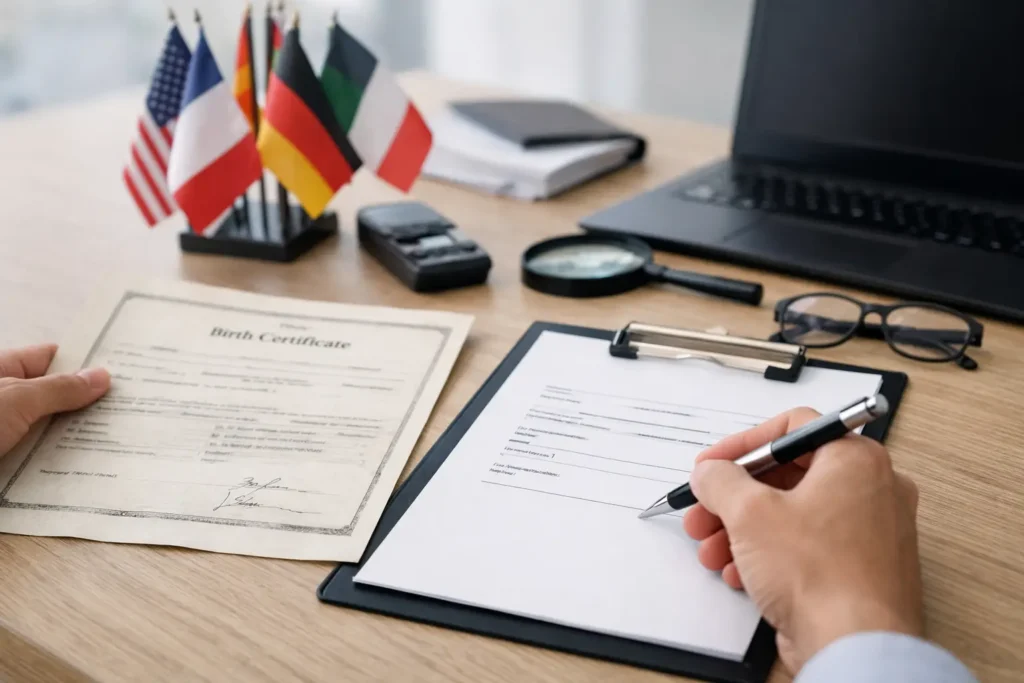
A birth certificate looks simple until an agency rejects it. One missing name format, one skipped stamp, or one uncertified translation can delay an immigration filing, school enrollment, passport application, or court matter. If you are trying to figure out how to translate birth certificate documents for official use in the United States, the key is not just converting words from one language to another. The translation must match the purpose, the receiving institution, and the required level of certification.
How to translate birth certificate for official use
The first step is to confirm who will receive the document. A translated birth certificate for USCIS may need a certification statement from the translator or translation company. A court, embassy, school, or state agency may ask for different formatting, notarization, or supporting records. That is why the right process starts with the end use.
You also need to work from a complete and readable copy of the original. If part of the certificate is cut off, blurred, handwritten beyond recognition, or missing a seal, the translation can become inaccurate or unusable. Official institutions expect the translated version to reflect the original document faithfully, including stamps, seals, signatures, marginal notes, and handwritten entries where legible.
A proper birth certificate translation usually includes every visible element on the page. That means names, dates, places of birth, registration numbers, official remarks, issuing authority, and any annotations added later. Nothing should be summarized or rewritten for convenience. Official translation is about accuracy, not simplification.
What a birth certificate translation must include
For most official purposes, a birth certificate translation needs more than fluent language skills. It needs document accuracy and formal compliance. The translated text should mirror the original structure as closely as possible while remaining clear in English.
Names require special attention. Some people assume the translator should “correct” spelling or replace a name with the version used in a passport. That can create problems. In many cases, the translation should reflect the original document exactly, while transliteration choices may need to stay consistent with other submitted records. If a person uses different spellings across immigration, school, or legal documents, that mismatch may trigger questions.
Dates and place names also need care. Different countries use different date orders, calendar systems, and geographic naming conventions. A translator should understand whether a date should be rendered exactly as written, converted for clarity, or accompanied by a note. The same is true for province names, municipalities, and civil registry terms that do not translate neatly into US English.
If the birth certificate includes seals, signatures, illegible handwriting, or printed labels, those details should be identified properly. Standard notations such as “[seal]” or “[illegible]” may be appropriate where necessary. Omitting those elements can make the translation look incomplete.
Certified vs. notarized vs. apostille support
This is where many people get confused. A certified translation is not the same thing as a notarized translation, and neither is the same as an apostille.
A certified translation generally includes the translated document plus a signed statement confirming that the translation is complete and accurate to the best of the translator’s knowledge and ability. This is commonly required for USCIS and many other US institutions.
A notarized translation usually means the translator or authorized representative signs the certification in front of a notary public. Some agencies ask for this extra step, but many do not. Notarization does not make the translation more accurate. It simply adds a formal layer of identity verification for the signer.
An apostille is different again. It applies to the original document or a certified copy for international recognition under specific treaty rules. If you are sending documents abroad, you may need both a certified translation and apostille support, depending on the destination country and the authority requesting the paperwork.
Because these requirements vary, the safest approach is to verify what the receiving agency actually wants before ordering the translation.
How to translate birth certificate without risking rejection
If the document is for immigration, legal, academic, or government use, machine translation is a bad gamble. A birth certificate has fixed terminology, civil registry language, abbreviations, handwritten notes, and formatting details that automated tools often mishandle. Even when the output looks readable, it may still be unacceptable because it lacks certification and misses official details.
Human translation matters most when the record contains older formatting, regional language, non-Latin scripts, or amendments added after the original issue date. These are common in birth records from many countries. A general bilingual speaker may understand the text but still miss the level of precision required for formal submission.
Professional translators who handle official documents know how institutions review them. They understand when to translate a heading literally, when to preserve a proper noun, how to mark stamps and seals, and how to keep the final version suitable for submission. That reduces the risk of a rejection that costs more time than the translation itself.
Common mistakes people make
The biggest mistake is assuming any translation will do. For official use, accuracy alone is not enough if the translation has no certification. The second common mistake is submitting only part of the document. If the back side contains registry notes, legalization marks, or annotations, that content may need to be translated too.
Another issue is inconsistent personal data. If the translated birth certificate shows a name or date format that conflicts with a passport, visa file, school record, or marriage certificate, the receiving authority may ask for clarification. That does not always mean the translation is wrong, but it can create delays.
People also wait too long to order the translation. If your filing deadline is close and the document needs certification, notarization, or apostille coordination, timing matters. Rush service may be available, but it is always better to leave room for review.
When certified translation is usually required
Birth certificate translation is commonly requested for immigration petitions, green card applications, visa processing, passport matters, dual citizenship applications, school admissions, marriage registration, court filings, adoption paperwork, and benefits applications. In each of these cases, the institution is relying on the document as proof of identity, family relationship, age, or nationality.
That is why a casual translation is rarely enough. The document must be ready for formal review. For many applicants, especially first-time filers, the safest choice is a certified translation prepared by a professional service familiar with USCIS, courts, embassies, and other official recipients.
What to prepare before ordering
Before you request a translation, gather a clear scan or photo of the full document. Check that every corner is visible and that all text, seals, and handwritten notes can be read. If the document has front and back content, include both sides.
You should also know where the translation will be submitted and whether the agency has special instructions. Some institutions want the original-language document attached to the translation. Others may ask for notarization or specific wording in the certification statement. Sharing that information upfront helps avoid revisions later.
If your case includes related records, such as passports, marriage certificates, or previous translations, it may help to provide them so names and place spellings stay consistent across the file.
Choosing the right provider
When the document affects immigration status, legal rights, education, or family matters, do not choose based on price alone. Look for a provider that handles certified document translation regularly, works with human translators, protects confidential information, and understands acceptance standards for US institutions.
Fast turnaround matters, but reliability matters more. A translation delivered quickly is not useful if it needs to be redone. A professional provider should be able to explain what is included, whether certification is provided, whether notarization is available, and how the final documents will be delivered. Companies such as AL Waseem Translation focus on this type of high-stakes document workflow because the real goal is not just translation – it is acceptance.
If you are unsure how to translate birth certificate records the right way, think less about word-for-word conversion and more about document readiness. The best translation is the one that moves your application forward without questions, delays, or corrections.