
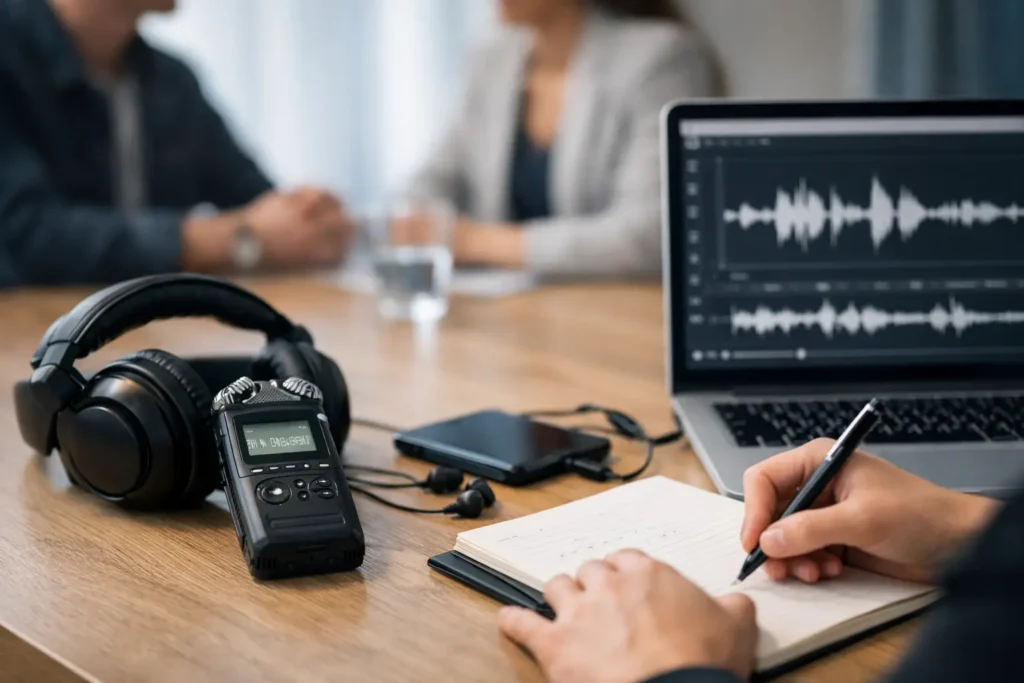
A single missed quote can change the meaning of an interview. A misheard medical term can create confusion. A wrong name in a legal or immigration matter can cause delays you do not need. That is why audio transcription services for interviews are not just a convenience. For many professionals, they are part of the record.
If you are transcribing interviews for research, legal review, HR documentation, journalism, healthcare, or multilingual business use, the right service depends on more than speed. You need accuracy, clear speaker identification, strong confidentiality practices, and a process that holds up when the content matters beyond internal note-taking.
What audio transcription services for interviews should actually deliver
At a basic level, a transcription service converts recorded speech into written text. For interviews, that sounds simple until you account for accents, overlapping speakers, industry terminology, poor audio quality, and code-switching between languages. Those details are where quality separates itself.
A useful transcript should preserve meaning without creating extra cleanup work. That means names should be checked carefully, speakers should be labeled consistently, timestamps should be available when needed, and unclear portions should be marked honestly rather than guessed. In high-stakes settings, guessing is not helpful. It is risky.
For many organizations, the transcript also needs to fit into a larger workflow. A law firm may need interview audio transcribed and then translated. A healthcare team may need an interview turned into text for internal documentation with strict confidentiality. A research group may need verbatim transcripts for qualitative analysis. The best service is the one that matches the actual use case, not the cheapest one advertised in a search result.
Human vs automated audio transcription services for interviews
This is the first decision that matters. Automated transcription can be useful for quick internal reference, especially when the recording is clear, the speakers are few, and the terminology is simple. It is fast and usually lower cost. If your goal is to scan a conversation, pull broad themes, or create rough notes, it may be enough.
But interviews are rarely that clean. People interrupt each other. They change direction mid-sentence. They use uncommon names, abbreviations, regional accents, and technical language. In those situations, automated output often needs extensive editing. What looked cheaper at the start can become expensive when staff must correct the transcript line by line.
Human transcription is slower and usually costs more, but it gives you something much closer to a finished document. That matters when the transcript may be used for legal preparation, compliance review, internal investigations, medical records support, academic research, or official translation. In those settings, precision is not optional.
There is also a middle ground. Some providers use speech recognition first and then assign a human editor to review and correct the file. That approach can work well if the provider is transparent about the process and the final transcript is actually reviewed by someone trained to catch terminology, context, and speaker changes.
Where accuracy matters most
Not every interview transcript carries the same level of risk. If a marketing team is transcribing customer interviews for brainstorming, small wording errors may be annoying but manageable. If the interview is tied to litigation, immigration, insurance, employee relations, or clinical information, the stakes are much higher.
Names, dates, addresses, case details, diagnoses, and direct quotes are frequent problem areas. So are recordings with multiple speakers or emotionally charged conversations where clarity drops. In multilingual interviews, one speaker may use English for part of the discussion and another language for the rest. That creates another layer of complexity, especially if the final text will later be translated or submitted to an institution.
In these cases, it is worth asking whether the transcription provider has subject-matter familiarity. A general transcriptionist may handle clean business interviews well but struggle with legal phrasing, medical terminology, or immigration-related details. Experience in the field reduces avoidable errors.
How to compare providers without getting distracted by marketing
Many services promise fast turnaround and high accuracy. Those claims are common. The better way to compare providers is to look at a few practical points.
First, ask how they handle speaker identification. Interviews are often useless in transcript form if every line runs together. Clear labels matter, especially for research, HR, and legal contexts.
Second, ask what happens when the audio is difficult. Some providers quietly fill in uncertain words. A better provider marks inaudible sections and flags concerns. Honest uncertainty is more valuable than confident error.
Third, review confidentiality standards. Interview recordings often contain personal data, internal business information, or protected health details. You should know who has access, how files are transferred, and whether the company is prepared to work with sensitive material.
Fourth, check whether the provider can support the next step. A transcript is not always the final deliverable. You may need certified translation, notarization support, or a formatted document suitable for court, immigration, or institutional review. Working with a language service provider that understands official-use requirements can save time later.
Turnaround time is important, but context matters
Fast delivery is valuable. Deadlines in legal, immigration, research, and business matters are real. But speed should be evaluated alongside audio length, complexity, and intended use.
A same-day transcript may be realistic for a short, clear interview. It is less realistic for several hours of difficult audio with multiple speakers and technical terminology. If a provider promises extreme speed on every file, ask what quality checks are being skipped.
A dependable service will usually give you a realistic turnaround based on recording conditions. That is a better sign than a blanket promise. Predictable delivery is more useful than a rushed transcript that has to be redone.
Audio quality affects everything
Even the best transcription team cannot create perfect text from poor sound. Background noise, low-volume speakers, echo, phone compression, and people talking over one another all reduce accuracy. This does not mean a difficult file should be rejected. It means expectations and process should be clear.
If you are recording interviews yourself, basic preparation helps. Use a quiet room, place microphones close to speakers, ask participants not to interrupt each other, and confirm names at the start of the recording. For remote interviews, stable internet and individual microphones improve results more than most people expect.
Good providers will also tell you whether your file is likely to need extra review. That kind of upfront guidance is part of professional service.
When multilingual interviews need more than transcription
Many interview projects involve more than one language. A witness may answer in Arabic, a patient may switch between Spanish and English, or an employee interview may involve an interpreter. In those situations, the service model matters.
Sometimes you need a source-language transcript first, followed by translation. In other cases, you may need direct transcription and translation into English. The right path depends on how the final document will be used. For official or legal purposes, separating the steps can be better because it preserves the original spoken content before translation decisions are made.
This is one area where a full-service language provider has a practical advantage. If transcription, translation, certification, and document support are handled under one professional workflow, there is less room for inconsistency between stages. For organizations and individuals dealing with official matters, that can reduce delays and confusion.
Who benefits most from professional transcription
Interview transcription is especially useful for attorneys, HR teams, healthcare providers, researchers, journalists, and businesses conducting internal reviews or customer interviews. It is also valuable for individuals who need a clear written record of conversations tied to immigration, education, insurance, or personal legal matters.
The common thread is not the industry. It is the need for a reliable record. Once the spoken word becomes text, it is easier to review, share internally, analyze, translate, and reference later. But only if the transcript is dependable.
For clients who need both transcription and institution-ready language support, AL Waseem Translation fits naturally into that process by combining professional transcription with human-led translation services for sensitive and official-use content.
Choosing the right service with fewer surprises
If your interview transcript is only for rough internal notes, automation may be enough. If it will support a legal file, research record, compliance issue, medical matter, or official translation, human review is the safer choice. The more sensitive the content, the less room there is for shortcuts.
A good provider should be clear about pricing, realistic about timing, careful with confidentiality, and honest about what your audio quality will allow. That is what professional service looks like. Not the biggest claim, but the fewest problems after delivery.
When you choose audio transcription services for interviews, think beyond the transcript itself. Think about where that document is going next, who will rely on it, and what it would cost if it is wrong. That is usually where the right decision becomes clear.