
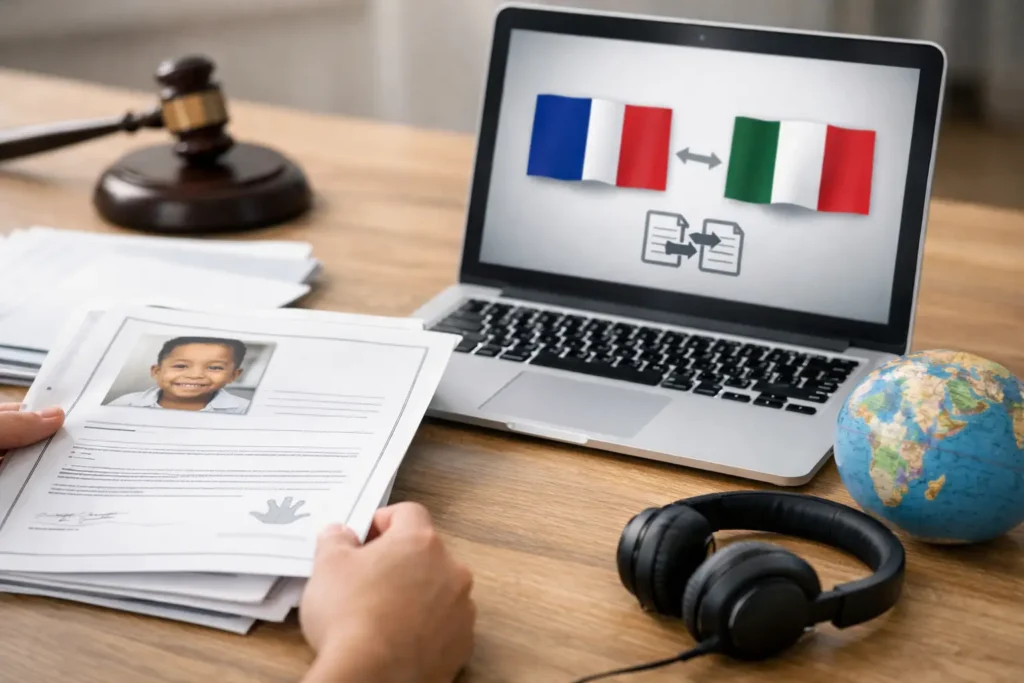
When a family is finalizing an adoption, a translation mistake is not a small clerical issue. One wrong date, one inconsistent name, or one missing court stamp can delay immigration processing, create questions from an agency, or force you to resubmit documents under tight deadlines. If you need to translate adoption papers correctly, the standard is simple: the translation must be complete, accurate, and ready for official review.
Adoption files often move through more than one authority at once. A family may need documents for USCIS, a state court, a foreign civil registry, an embassy, or a school system. Each institution may look at the same paperwork for a different reason, which means the translation has to do more than sound right in English. It has to preserve the legal meaning of the original document exactly.
Why adoption document translation requires extra care
Adoption paperwork is unusually sensitive because it combines legal, personal, and immigration information in one file. A single packet may include birth records, consent forms, court judgments, home study documents, identity records, medical reports, and post-adoption certificates. These are not general documents that can be paraphrased. They are official records tied to a child’s identity, a parent’s legal status, and the validity of the adoption itself.
That is why adoption translations should always be handled by a human translator with document experience. Machine output can miss context, flatten legal terms, or mishandle names that must stay consistent across every page. In adoption matters, consistency is not cosmetic. If one document says “decree of adoption,” another says “adoption order,” and a third uses a vague phrase that changes the meaning, the receiving agency may ask whether these documents refer to the same legal act.
The risk goes beyond wording. Official reviewers also examine signatures, seals, handwritten notes, stamps, marginal comments, and registration numbers. If those elements are omitted, the translation may be considered incomplete.
What it means to translate adoption papers correctly
To translate adoption papers correctly, the translator must reproduce the full content of the original document into the target language without adding interpretation or leaving anything out. That includes visible text, official marks, dates, names, case numbers, notations, and formatting cues that help the reviewer match the translation to the source.
Accuracy starts with names. In adoption files, a child may appear under a birth name, a temporary legal name, and an adoptive name. Parents may have middle names, patronymics, or alternate spellings across different countries’ records. The translator should not “fix” those differences unless the document itself provides the correction. Instead, the translation should reflect the original and preserve the record as issued.
Dates are another common problem. Some countries use day-month-year format, while US agencies may read month-day-year by default. A correct translation makes the intended date clear and keeps it consistent. The same rule applies to places of birth, registry references, and legal terminology. Precision matters because these details are often used to match one document against another.
Which adoption documents often need certified translation
The exact set depends on the case, but families and attorneys commonly submit foreign birth certificates, adoption decrees, court orders, parental consent records, abandonment determinations, identity documents, marriage certificates, home study materials, and medical records. If the adoption is tied to immigration processing, additional supporting records may also need translation.
For US use, many agencies require certified translation. That usually means the translation comes with a signed certification stating that the translation is complete and accurate and that the translator is competent to perform it. USCIS, courts, and other institutions may have specific expectations, so it is wise to confirm whether certification alone is enough or whether notarization or other supporting steps are also required.
This is where many people lose time. They assume any bilingual person can translate the file, only to learn later that the receiving agency needs a formal certification statement, complete page-for-page translation, and institution-ready formatting.
Common mistakes that cause delays
Some errors are obvious, but many are subtle. Partial translation is one of the biggest problems. People sometimes translate only the main body of a decree and leave out seals, handwritten entries, or side notes. Official reviewers may reject that version because the source document was not translated in full.
Another common issue is inconsistent terminology. Adoption law varies by country, and terms do not always have a neat one-word equivalent in English. A qualified translator has to choose language that is both accurate and understandable in the US legal context without changing the original meaning.
Formatting also matters more than most people expect. If a translation is hard to compare with the original, the reviewer has to work harder, and that can raise unnecessary questions. Clean structure, matching order, and clear identification of stamps or signatures make the review process easier.
Then there is confidentiality. Adoption files include deeply personal information about children and families. Sending them through informal channels or using unvetted tools creates avoidable risk. A professional translation provider should treat these records as confidential from the first upload to final delivery.
How to choose the right translation service
If the documents will be used for legal, immigration, or court purposes, choose a provider that handles certified translations for official use on a regular basis. Experience with high-stakes documentation matters because the translator and review team need to understand how agencies read records, what must be preserved, and where inconsistencies usually appear.
Ask practical questions. Will the translation be certified? Is it completed by human translators? Can the provider handle legal and civil documents from the country of origin? Do they keep names, dates, seals, and document structure consistent? Can they provide fast turnaround if a filing deadline is close?
It also helps to work with a company that can support related requirements, such as notarized translation or apostille assistance, when those steps are needed. Not every adoption case requires the same workflow, and that is exactly why a one-size-fits-all approach causes trouble.
How to prepare your documents before sending them
Good source files lead to better translations. Scan every page clearly, including backs of pages if they contain stamps or notes. Do not crop out seals, signatures, or borders. If a document is difficult to read, mention that in advance rather than waiting for the translator to guess.
Keep all versions together if the file includes amendments, updated certificates, or later court actions. Adoption records often evolve over time, and what looks like a duplicate may actually be the most current legal version. If you already know the documents are intended for USCIS, a court, an embassy, or another authority, say so at the beginning. The translation team can then prepare the file with the right level of certification and presentation.
If spellings differ across documents, flag that as well. A professional translator should preserve the source text, but advance notice helps the review process and can reduce back-and-forth later.
When certified translation is not the only step
Translation is often one part of a larger compliance process. Some adoption records may also need notarization, apostille support, or submission in a specific package format depending on where they will be used. A court may want one thing, an embassy another, and a state office something slightly different.
That is why the best approach is to think beyond the translation itself. The real goal is acceptance. A document is only useful if the receiving institution can review it without questioning its completeness, accuracy, or form.
For families under time pressure, that distinction matters. Fast service is valuable, but speed without quality can create a second round of delays. A reliable provider should balance quick turnaround with careful review, especially when the paperwork affects a child’s legal identity and a family’s next steps.
AL Waseem Translation works with official documents that require certified accuracy, human review, and readiness for submission to US agencies and institutions. That kind of support matters most when the paperwork carries legal weight and there is little room for error.
Translate adoption papers correctly the first time
Adoption paperwork deserves careful handling because the stakes are personal and legal at the same time. The best translation is not the cheapest or the fastest on paper. It is the one that preserves every detail, meets the receiving authority’s expectations, and helps your documents move forward without avoidable questions.
If you are preparing an adoption file, treat translation as part of the legal process, not an afterthought. A complete, certified, human-reviewed translation can make the difference between a smooth submission and a stressful delay at exactly the wrong moment.