
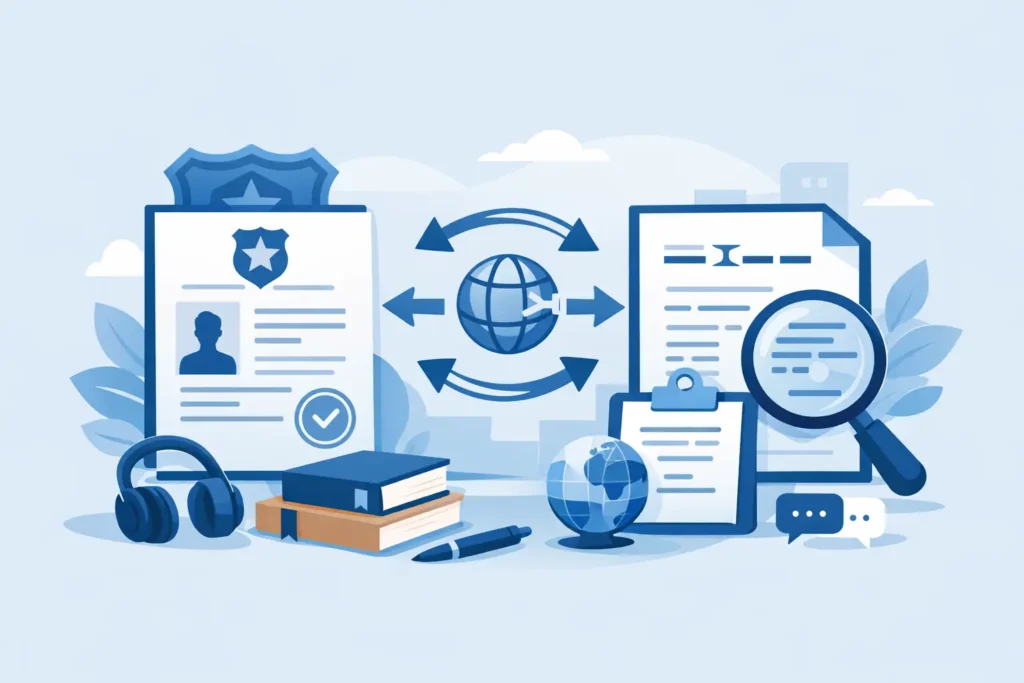
Translate Police Clearance Certificate Al Waseem
A police clearance certificate can hold up a visa case, job application, adoption file, or residency process for one simple reason: the translation is not accepted. If you need to translate police clearance certificate documents for USCIS, an embassy, a court, or an employer, accuracy is only part of the job. The translation also needs to be complete, properly formatted, and suitable for official review.
This is not a document where rough translation or machine output is good enough. Police clearances contain legal terms, issuing authority details, dates, stamps, reference numbers, and notations that can affect how the document is interpreted. A small mistake can create questions about identity, criminal history, or document authenticity.
Order Translation Instantly.
When do you need to translate a police clearance certificate?
A police clearance certificate is often required when a person must prove criminal background status in another country or before a US institution. Common cases include immigration filings, visa applications, consular processing, international employment, licensing, study abroad, and family-based legal matters.
In the United States, many applicants need a certified English translation when the original certificate was issued in another language. USCIS, attorneys, schools, licensing boards, and foreign consulates may all have slightly different expectations. Some only require a certified translation. Others may also ask for notarization or assistance with supporting documents, depending on the case.
That distinction matters. A translation that works for one agency may not be enough for another. This is why the safest approach is to prepare the document for its exact destination rather than assume every office follows the same standard.
What makes this document different from ordinary translation?
Police clearance certificates are official records. They are usually short but dense with information. That means the translator has to preserve meaning with precision, not simplify the language.
A proper translation should reflect the original document faithfully, including names, dates, document numbers, seals, stamps, handwritten notes, and any visible remarks. If a field says there is no criminal record, that wording must be translated clearly and accurately. If the document shows pending matters, administrative language, or local legal phrases, those terms must be handled by someone familiar with official records.
This is where human expertise matters. Legal and administrative language does not always translate cleanly word for word. A phrase used by a police authority in one country may not have an exact US equivalent. The translator has to choose wording that is accurate, understandable, and acceptable to the receiving institution without changing the meaning.
Certified translation vs. regular translation
If you are submitting a police clearance certificate to a US authority, a certified translation is usually the standard requirement. In practical terms, this means the translation comes with a signed certification stating that the translation is complete and accurate and that the translator or translation provider is competent to perform the work.
This is different from casual bilingual help or a basic document conversion. A friend who speaks both languages may understand the certificate, but that does not make the translation acceptable for official use. Most institutions want a formal certification statement because they are reviewing the document as evidence.
For some situations, certified translation is enough. For others, you may not need notarization, or you may need help coordinating apostille-related steps if the document is part of an international process. It depends on where the certificate was issued and where it is being submitted.
How to translate police clearance certificate documents the right way?
The process should be simple, but it should not be casual. Start with a clear scan or photo of the entire document. Every corner, seal, stamp, and signature area should be visible. Cut-off images create risk because even a small missing mark can matter in an official review.
Next, identify the receiving institution. Are you submitting the translation to USCIS, a consulate, a court, a university, or a private employer? That determines whether you only need a certified translation or if extra steps may be required.
Then, make sure the translator is experienced with official and legal documents. A police clearance certificate may look straightforward, but the language often includes jurisdiction-specific wording. An experienced provider will know how to handle abbreviations, local police authority names, issue dates, and status statements without making the translation look improvised.
Finally, review the translated names and numbers carefully. The spelling of your name should match your passport or the identity document used in your application. Dates should be consistent with the original format and interpreted correctly. This is especially important when the original document comes from a country using a day-month-year order that could be confused in a US review.
Common mistakes that cause rejection or delays
The most common problem is incomplete translation. Some people assume stamps, seals, preprinted labels, side notes, or signature lines do not need to be translated. In many official settings, they do. If something appears on the original, it should usually be accounted for in the translation.
Another issue is poor name consistency. If your police clearance certificate shows a spelling variation from your passport or immigration file, that difference may need to be reflected exactly as written and, in some cases, explained through supporting documentation. The translator should not guess or “correct” names unless the original clearly contains a typographical issue and the context is documented.
Machine translation is another frequent source of trouble. Automated tools can mishandle legal phrases, formatting, and context. A phrase intended to confirm no criminal record may come out awkward, vague, or inaccurate. That kind of error can trigger unnecessary scrutiny.
There is also the issue of certification language. If the translation does not include a proper certification statement when one is required, the receiving office may reject it even if the translated text itself is accurate.
What institutions usually expect?
USCIS generally requires any foreign-language document submitted in support of an application to be accompanied by a full English translation and a certification of accuracy and translator competence. Courts, embassies, and consulates may have similar standards, but some add their own procedural requirements.
Employers and licensing boards can be less predictable. One may accept a standard certified translation, while another may request notarization or ask for the translation to reproduce the original layout more closely. This is why document readiness matters. A translation should not only be correct – it should be prepared in a way that suits the institution reviewing it.
For high-stakes submissions, many clients choose a provider that handles certified translation regularly for legal and immigration use. That reduces the chance of preventable formatting or compliance errors.
Choosing a translation provider for official documents
When your police clearance certificate affects travel, legal status, or employment, speed matters, but accuracy matters more. Look for a provider that uses human translators, has experience with official records, and understands certified translation requirements in the US.
Confidentiality should also be part of the decision. Police documents contain sensitive personal information, including identity details and criminal background status. You should know who is handling the file and whether the company has a professional process for secure document management.
It also helps to work with a provider that can support related services if your case requires them. Some clients only need a certified translation. Others later discover they also need notarization, apostille support, or interpretation for a legal or consular appointment. Working with a company that understands the full compliance chain can save time.
AL Waseem Translation is one example of the kind of provider many applicants look for – human-only translation, certified document support, and service built around official acceptance in the United States.
Timing, urgency, and what to prepare
Police clearance certificates are often time-sensitive. Some embassies and agencies only accept certificates issued within a certain validity window. If translation is delayed, the document itself may become outdated before submission.
That is why it is smart to order the translation as soon as you have the final document in hand. Do not submit an unofficial draft if you expect the police authority to issue a corrected or updated version later. Any change in date, reference number, or signature can require a fresh translation.
Before placing the order, prepare the full document, confirm the target language if English is required, and note the agency receiving it. If you already know you will need certification, notarization, or other formalities, mention that from the start. It is easier to build the translation package correctly than to revise it after submission rules become urgent.
A police clearance certificate may be only one page, but it can carry a lot of weight. When the document is translated correctly, certified properly, and matched to the institution reviewing it, you remove one more obstacle from an already serious process. That peace of mind is usually worth doing it right the first time.