
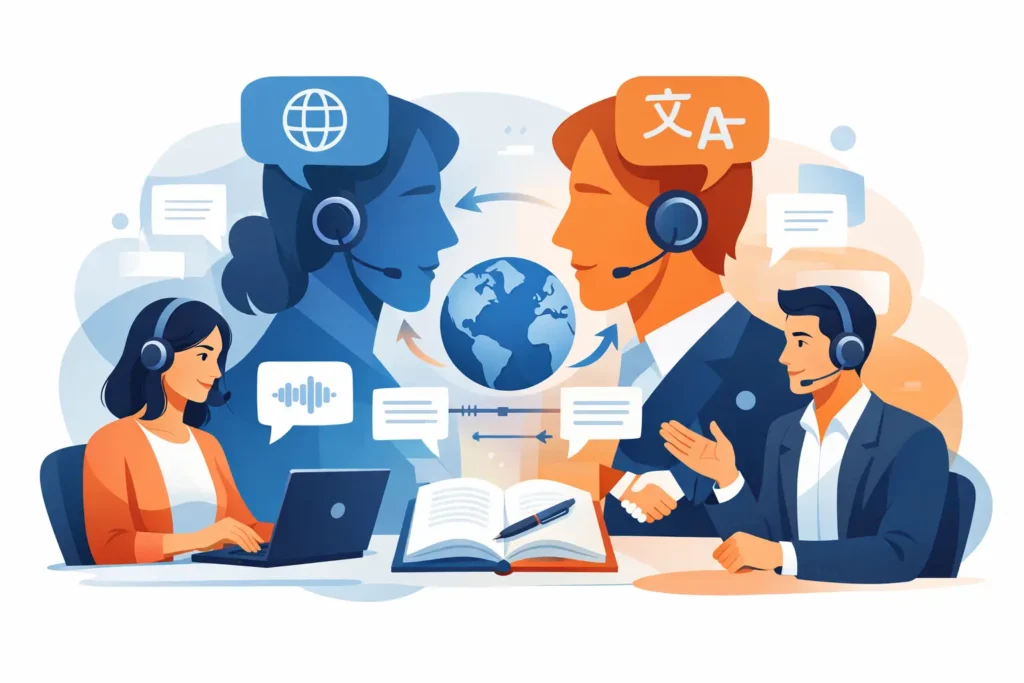
Why Human Translation Services? Al Waseem
A birth certificate for USCIS, a medical report for treatment, a contract for court, an academic transcript for admission – these are not documents you can afford to get almost right. Human translation services remain the standard for high-stakes communication because official acceptance depends on more than word replacement. It depends on accuracy, context, formatting, and the judgment of a qualified professional who understands what the document is meant to do.
That distinction matters most when the translation will be reviewed by an institution rather than just read by a person. Government agencies, courts, hospitals, universities, and employers are not looking for a rough interpretation. They need a complete and faithful translation that clearly reflects the source document and can withstand formal review. When deadlines are tight and the consequences are real, the quality of the translator is not a minor detail. It is the service.
Order Translation Instantly.
What human translation services actually provide
Human translation services are performed by real translators who understand both languages and the subject matter involved. They do not simply convert words. They interpret meaning, preserve intent, and make informed decisions about terminology, tone, structure, and legal or institutional expectations.
That matters because language is rarely literal. A phrase that makes sense in one country may carry a different legal meaning in another. A handwritten note on a medical file may need careful interpretation. A civil record may include administrative terms that have no exact one-word equivalent in English. A machine can miss those differences. A trained human translator is expected to catch them.
For official use, the work often includes more than the translation itself. It may require certification, a signed statement of accuracy, formatting that mirrors the original, support for notarization, or readiness for apostille processing. In these cases, the value is not just linguistic accuracy. It is document readiness.
Why human translation services matter for official documents
Official documents are judged on precision. If a marriage certificate contains names, dates, stamps, seals, marginal notes, or handwritten amendments, all of that may need to appear correctly in the translated version. Omissions, guesswork, or inconsistent terminology can cause delays, requests for resubmission, or outright rejection.
Immigration filings are a clear example. USCIS generally requires certified translations for any document submitted in a foreign language. The translation must be complete, accurate, and accompanied by the proper certification statement. A casual translation or automated output may save time at first, but it can create a much bigger problem if the document is not accepted.
The same is true for court matters, medical records, and academic documents. A mistranslated diagnosis can affect care. A poorly translated legal clause can change the meaning of an agreement. A transcript with inconsistent course names or grading terms can create confusion during evaluation. These are not edge cases. They are common reasons people seek professional help in the first place.
Human translation services vs machine output
Machine translation has improved for basic communication. It can help someone understand a menu, a simple email, or a general webpage. For low-risk use, that can be enough. But official documentation operates under a different standard.
The issue is not only whether the words are understandable. The issue is whether the translation is reliable, complete, and acceptable to the receiving authority. Machines struggle with ambiguity, cultural context, legal phrasing, handwriting, document conventions, and industry-specific terminology. They also cannot take responsibility for the result in the way a professional service can.
There is also a confidentiality concern. Sensitive files often contain passport details, addresses, medical information, financial records, or case histories. Many individuals and organizations are not comfortable placing that information into open automated tools. Human-only workflows with professional handling offer a stronger level of privacy and accountability.
That does not mean every project needs the same level of specialization. A simple personal letter is different from a court filing. But when acceptance, compliance, or liability is involved, human review is not an extra feature. It is the requirement.
When you should choose human translation services
If your document is going to USCIS, a court, an embassy, a consulate, a university, a hospital, or a government office, human translation services are usually the right choice. The same applies if the document includes technical language, signatures, stamps, handwritten comments, or formatting that must be preserved.
Business use cases also call for human expertise more often than people assume. Vendor agreements, employee records, compliance documents, product materials, and financial statements all carry risk if translated carelessly. In business, a translation error can slow transactions, create internal confusion, or damage credibility with partners and regulators.
For personal matters, the stakes can be just as high. Families often need translations for birth certificates, marriage certificates, divorce judgments, diplomas, police clearances, and death certificates. These documents are deeply personal, but they are also administrative records. They must be handled with care and presented in a form that institutions can accept.
What to look for in a provider of human translation services
Not all providers offer the same level of readiness. If you need a translation for official use, start by checking whether the service handles certified translations and understands the requirements of the institution receiving the document. Speed matters, but accuracy and acceptance matter more.
Subject-matter expertise is another key factor. Legal, medical, academic, and corporate documents each have their own terminology and conventions. A generalist may be able to translate the words, but that does not always produce an institution-ready result. The best providers match the document to a translator who understands the field.
You should also ask about confidentiality, turnaround times, and delivery options. Many clients need to order online or by email, especially when time is tight, or they are located outside a major city. A dependable provider should make the process straightforward without treating sensitive documents casually.
Finally, consider whether you may need related services. In many cases, translation is only one step. You may also need notarization, apostille support, interpretation, or transcription. Working with a provider that understands the full process can save time and reduce the chance of procedural errors.
Why subject-matter expertise changes the outcome
A certified translation is not automatically a good translation. Certification addresses the formal declaration of accuracy, but the underlying work still depends on the translator’s skill. That is why subject-matter knowledge matters so much.
In medical translation, for example, terminology must be precise and readable. A translator has to recognize abbreviations, understand test names, and avoid wording that could distort a diagnosis or treatment history. In legal translation, the translator must preserve meaning without improvising. Even small differences in phrasing can matter when a judge, attorney, or agency officer reviews the file.
This is where human translation services continue to outperform automated tools and low-cost shortcuts. They provide judgment. They account for the fact that documents are created for different systems, by different authorities, and for different purposes. Good translators do not flatten those differences. They manage them.
A practical standard for high-stakes documents
When people search for translation help, they are often already under pressure. A filing deadline is approaching. A school is waiting for records. A patient needs continuity of care. A family is trying to complete the immigration process correctly the first time. In those moments, the right question is not what is fastest or cheapest on the surface. It is what will be accepted, trusted, and usable when it matters.
That is why professional providers such as AL Waseem Translation focus on human-only workflows for official and sensitive documents. The goal is not simply to produce text in another language. The goal is to deliver an accurate translation, properly prepared, and ready for the institution that will review it.
If your document affects legal status, healthcare, education, employment, or cross-border business, choose a service built for that level of responsibility. A good translation does more than read well. It helps your documents move forward without avoidable problems.