
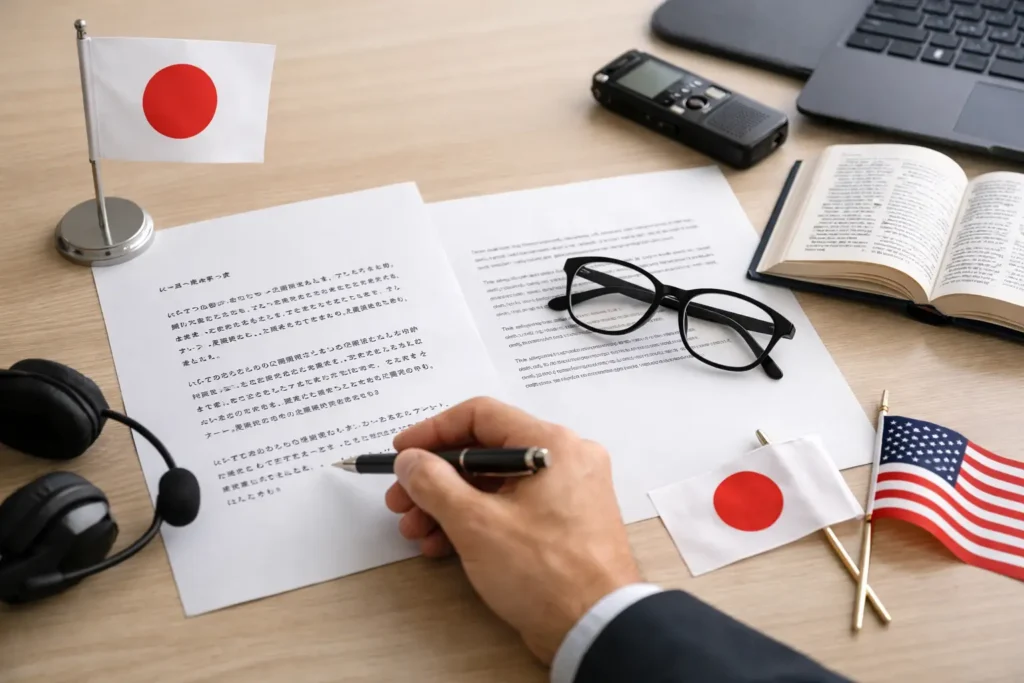
Japanese Language Transllation for Official Use Explained
A small wording mistake in a Japanese document can create a very real problem when that document is headed to USCIS, a court, a university, or a hospital. Japanese language translation is not just about converting words into English. It is about preserving meaning, format, context, and official usability so the final document can be accepted without delay.
That is why Japanese translation for official use needs a higher standard than casual or general-purpose translation. Names must match identity records. Dates must be interpreted correctly. In institutional terms, seals, handwritten notes, and stamped annotations all need careful treatment. When the document affects immigration status, legal proceedings, medical care, education, or business approval, accuracy is not optional.
Order Translation Instantly.
When Japanese language translation becomes high stakes
Many clients first look for translation after receiving a deadline. A visa application is moving forward. A school requests translated transcripts. A law firm needs supporting evidence for a case. A hospital needs a translated medical record before treatment planning. In these moments, speed matters, but acceptance matters more.
Japanese documents often include details that do not translate neatly into US administrative language. Family registers, academic records, contracts, court papers, business certificates, and medical reports can contain formatting conventions and terminology that require subject-matter judgment. A literal translation may be technically complete and still fail in practice if it creates confusion for the receiving institution.
This is where human expertise matters. Official translation work requires a translator who understands both languages and the purpose of the document. The goal is not to make the text sound elegant. The goal is to make it accurate, clear, and institution-ready.
What makes Japanese translation different
Japanese presents challenges that many clients do not see until a document is reviewed closely. The writing system alone can involve kanji, hiragana, katakana, Roman letters, and handwritten elements on the same page. Personal and place names may also have more than one accepted Romanization, which means consistency across passports, birth records, diplomas, and immigration files becomes essential.
Date formats are another common issue. Japanese documents may use era-based dating systems, and these must be interpreted correctly in English. A single mistake in date conversion can affect timelines in immigration cases, employment verification, and legal submissions.
There is also the question of equivalency. Some official terms in Japanese institutions do not map perfectly onto US systems. That does not mean the translator should guess. It means the translator must render the term in a way that remains faithful to the source while still being understandable to the US agency, court, school, or employer reviewing it.
Certified Japanese language translation for USCIS and immigration
Immigration is one of the most common reasons people need Japanese language translation in the United States. USCIS requires complete and accurate English translations for foreign-language documents submitted with applications and petitions. That usually includes a certification statement confirming that the translation is accurate and complete and that the translator is competent to translate the language pair.
For applicants with Japanese civil documents, this can involve birth certificates, marriage certificates, divorce records, police certificates, passports, family registers, and supporting identity documents. What matters here is not just language accuracy, but completeness. Every visible element that carries meaning should be accounted for, including seals, stamps, marginal notes, and official notations.
This is one area where shortcuts can become expensive. Machine output, informal translation by a friend, or incomplete page-by-page handling may trigger requests for evidence or create unnecessary delays. A certified translation prepared for official submission reduces that risk and gives the receiving agency what it expects.
Legal and court documents require a different level of precision
Legal Japanese translation calls for more than bilingual ability. Court filings, affidavits, contracts, judgments, powers of attorney, and evidentiary records depend on exact wording. A small shift in meaning can affect legal interpretation, especially when rights, obligations, or timelines are involved.
Japanese legal documents may contain formulaic language, references to local legal structures, and formatting conventions unfamiliar to US readers. The translator has to preserve the legal meaning without oversimplifying it. In some cases, notarization or additional procedural support may also be needed, depending on where the translated document will be filed.
For law firms and individual clients, the best approach is usually to treat translation as part of case preparation, not as an afterthought. If the translated document will be reviewed by a judge, clerk, opposing counsel, or government body, it should be prepared with that audience in mind.
Medical and academic translations leave little room for error
Medical records and school documents may seem more straightforward, but they can be just as sensitive. A Japanese medical report may contain specialized terminology, dosage information, procedural history, physician notes, and diagnostic detail that need careful handling. If a translation is too loose, the receiving provider may not be able to rely on it. If it is too literal without context, the result can be misleading.
Academic translations raise another type of challenge. Universities, licensing boards, and employers often need transcripts, diplomas, enrollment records, or recommendation materials translated clearly and consistently. Course titles, grading terminology, institutional designations, and issue dates must be translated in a way that supports fair review. This is especially important for international students, professionals seeking licensure, and applicants transferring credentials into US systems.
Why human-only translation still matters
For everyday browsing, automated translation tools can be useful. For official documents, they are not enough. Japanese is highly context-dependent, and many records contain condensed phrasing that only makes sense when read by someone familiar with institutional language and document purpose.
A human translator can evaluate tone, implied meaning, layout, and domain-specific terminology in ways software cannot reliably manage. That matters when the translation needs to be accepted by USCIS, courts, healthcare providers, employers, academic institutions, or consular authorities.
Human review also catches practical issues that software misses. Is the applicant’s name consistent with the passport? Does a stamp carry legal significance? Is a handwritten correction part of the record? Is an abbreviation standard, local, or case-specific? These details often determine whether a translation is truly ready for official use.
How to choose a Japanese translation provider
If your document is headed to an official institution, the safest choice is a provider that works with certified translations regularly and understands compliance expectations in the United States. Fast turnaround matters, but the better question is whether the translation will be usable the first time.
Look for a service that handles document translation with certification when needed, offers confidentiality, and has experience with legal, medical, academic, and immigration records. If your case may also require notarization, apostille support, transcription, or interpretation, it helps to work with a provider that can coordinate those services rather than leaving you to manage multiple vendors.
It also helps to ask practical questions early. Does the receiving institution need a certified translation? Do you need a digital copy, a mailed hard copy, or both? Will formatting matter? Is there a filing deadline? These are small questions that prevent bigger problems.
A company like AL Waseem Translation is built around that kind of process-driven support, which is often what clients need most when documents are time-sensitive, and acceptance is critical.
Common mistakes to avoid with Japanese document translation
The most common mistake is assuming any bilingual person can handle an official document. Fluency alone does not equal translation competence, especially in legal, medical, or immigration settings. Another mistake is waiting until the deadline is too close, which limits review time and can force rushed decisions.
Clients also sometimes submit only the text they think is important rather than the full document. That can cause omissions if the receiving authority expects stamps, notes, headers, or reverse-side content to be translated as well. And finally, some choose the cheapest option without checking whether the translation includes certification or is prepared for official acceptance. Lower cost at the start can lead to rejection, resubmission, and added delay.
What a reliable final translation should deliver
A strong Japanese translation should do three things at once. It should accurately reflect the source document, read clearly in English, and meet the expectations of the institution receiving it. If one of those pieces is missing, the translation may still cause trouble.
That is why the best translation process is careful, not casual. It respects terminology, document structure, and official purpose. It accounts for compliance needs without making the client sort out technical details alone. Most of all, it gives people something they can actually use – whether they are filing an immigration case, responding to a legal request, enrolling in school, documenting medical history, or closing a business transaction.
If your Japanese document carries legal, personal, or financial consequences, treat translation as part of the decision itself. The right translation does not just say the same thing in English. It helps your document move forward with fewer questions and more confidence.