
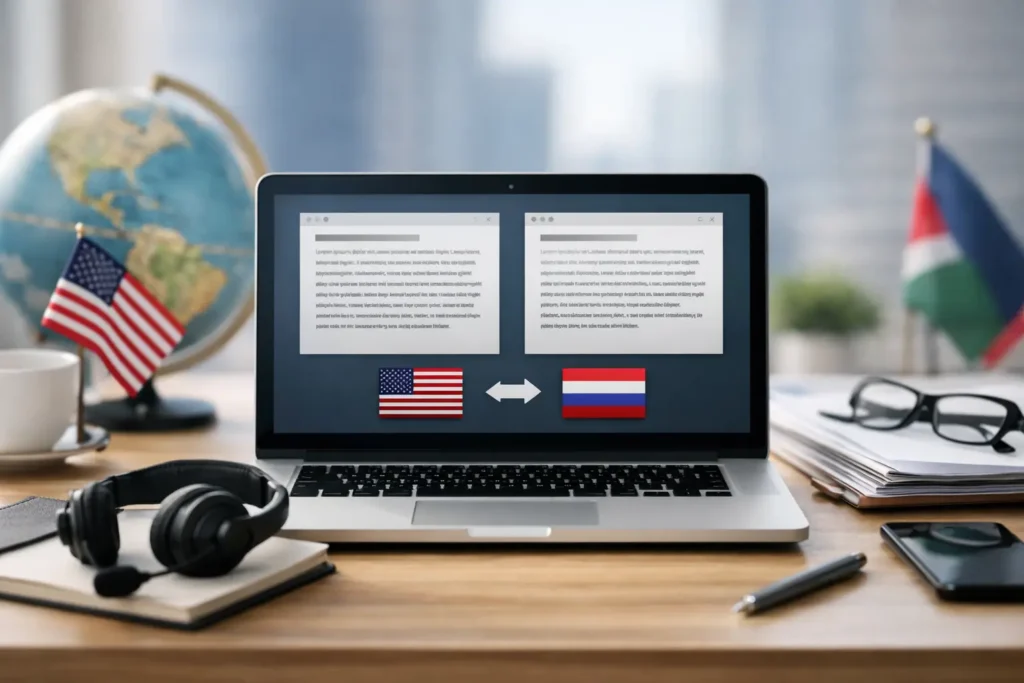
Professional Translation Services Online Across USA Explained
A missed word in a birth certificate can delay an immigration filing. An unclear medical record can slow treatment. A poorly translated contract can create legal risk that costs far more than the translation itself. That is why many people now look for professional translation services online in 150+ languages across the USA – not just for convenience, but for accuracy, compliance, and peace of mind.
When documents are headed to USCIS, courts, universities, embassies, hospitals, or corporate partners, the standard is higher than basic bilingual ability. What matters is whether the translation is complete, precise, formatted correctly when needed, and acceptable for official use. For individuals and organizations alike, online access makes the process faster. The real question is whether the provider behind that online service understands what is at stake.
Order Translation Instantly.
What professional translation services online across the USA should actually provide?
Online translation is not simply uploading a file and receiving an English version back. For high-stakes documents, the service should be built around human expertise, document handling procedures, and official-use requirements.
A reliable provider starts with the purpose of the translation. A marriage certificate for USCIS is not handled the same way as a medical report for a specialist, and neither is handled like a shareholder agreement for a business transaction. The terminology, formatting expectations, and supporting documents can all vary. If a provider treats every file the same, that is usually a warning sign.
Strong translation services also cover more than the text itself. Many clients need certification statements, notarization, sworn translation support, apostille assistance, interpretation, or transcription as part of the same process. That is especially helpful when deadlines are tight and multiple institutions are involved.
Why online access matters for urgent and official documents
The biggest advantage of online service is speed, but speed only matters if the final document is accepted. Across the USA, people often need to submit files quickly while dealing with agencies or institutions in another city or state. Online ordering removes geography from the equation.
A client in Texas can submit academic records for a university application. A family in Florida can send civil documents for immigration processing. A law firm in New York can request litigation-related translation without waiting for in-person appointments. In each case, the right online workflow reduces delays while keeping the work controlled and trackable.
There is also a confidentiality benefit when the provider has a professional intake process. Sensitive records should move through secure channels, be assigned to qualified linguists, and be reviewed before delivery. Convenience should never come at the expense of document security.
Professional translation services online in 150+ languages across the USA
Language coverage matters more than many clients expect. Some cases involve widely requested languages such as Spanish, Arabic, French, Chinese, or Russian. Others involve less common languages that still require the same level of accuracy and legal acceptability.
A provider that offers professional translation services online in 150+ languages across the USA can support a much wider range of personal and institutional needs. This is especially important for immigration cases, multicultural healthcare settings, international business, and legal matters involving records from multiple countries. It also helps clients avoid the risk of using one provider for a common language and then scrambling to find a second provider for a supporting document in another language.
That said, broad language coverage only adds value when qualified human translators are involved. A long language list is not enough on its own. The real standard is whether the provider can assign subject-matter specialists who understand the terminology and context of the file.
Where human-only translation makes the difference
Official documents do not leave much room for interpretation. Names, seals, annotations, handwritten notes, and legal phrasing all need careful treatment. Automated tools may be fast, but they can miss context, mistranslate fixed legal expressions, or mishandle formatting that matters to reviewers.
Human translators are better equipped to recognize when a term has no direct equivalent, when a document contains institution-specific language, or when a literal translation would confuse the receiving authority. They can also flag issues before submission, such as missing pages, unclear scans, or discrepancies between documents.
For legal, medical, and immigration use, this matters. Accuracy is not just about sounding fluent. It is about producing a translation that can stand up to scrutiny.
Common documents that require certified online translation
Many clients first search for translation help because an agency has specifically asked for a certified translation. This is common with birth certificates, marriage certificates, divorce decrees, passports, diplomas, transcripts, police records, and death certificates. It is also common with bank statements, employment letters, court filings, and medical documents.
Business clients often need translated contracts, compliance materials, employee records, technical manuals, corporate formation documents, and cross-border correspondence. Healthcare organizations may need patient records, consent forms, discharge summaries, and specialist reports. Law firms may need affidavits, witness statements, judgments, and evidentiary documents.
The key point is that the translation should match the intended use. Some institutions require certification. Others may request notarization. Some international filings may need apostille support as part of the process. Knowing which level applies can save time and prevent rejection.
How to choose the right provider
If your documents affect legal status, education, employment, healthcare, or court proceedings, the cheapest option is rarely the safest one. A better approach is to look at a few practical indicators.
First, confirm that the provider handles certified translations for official use in the United States. Second, ask whether the work is completed by human translators with subject-matter experience. Third, check whether the company supports related services such as notarization, apostille processing, interpretation, or transcription. That usually signals a deeper understanding of document workflows.
Turnaround time matters too, but it should be realistic. Same-day service can be useful for short personal documents. Larger legal or medical files may require more time for proper review. A dependable provider will be clear about timing instead of making promises that put accuracy at risk.
Customer support is another factor people underestimate. When a client is dealing with USCIS deadlines or court requirements, they often need direct answers, not vague updates. Clear communication is part of professional service.
What a nationwide service should look like
Nationwide service does not just mean accepting orders from all 50 states. It means understanding that institutions across the country may have different submission habits, while still producing translations that meet common official standards.
For clients, this should feel straightforward. You send the document online, receive confirmation, get a clear quote and timeline, and receive a completed translation that is ready for its intended use. If certification, notarization, or apostille support is needed, those steps should be explained clearly before the order moves forward.
This model works well for both individuals and organizations because it reduces friction. A student applying to a US university needs a simple process. A hospital handling multilingual records needs consistency. A law office managing multiple client files needs reliability at scale.
When specialized support matters most
Some documents are routine. Others are not. Court materials, psychiatric evaluations, immigration records with handwritten annotations, and technical business agreements usually require more than general language knowledge.
This is where specialization becomes visible. An experienced provider knows that medical accuracy affects patient care, legal accuracy affects outcomes, and immigration accuracy affects timelines and status. They do not treat these as generic translation jobs.
For that reason, many clients across the country choose providers built specifically for official and institution-ready work. Companies such as AL Waseem Translation are structured around that need – combining certified translation with services like notarization, apostille support, interpretation, and transcription so clients do not have to coordinate multiple vendors for one case.
A better standard for document translation
The real value of professional online translation is not that it saves a trip across town. It is that it gives people access to accurate, human-prepared, officially usable documents wherever they are in the USA. That matters when deadlines are close, requirements are strict, and the documents affect something bigger than paperwork.
If your translation will be reviewed by USCIS, a court, a university, a hospital, an embassy, or a business partner, choose a service that treats the document accordingly. Fast delivery is helpful. Wide language coverage is helpful. What counts most is whether the final translation is ready to be trusted the moment it arrives.