
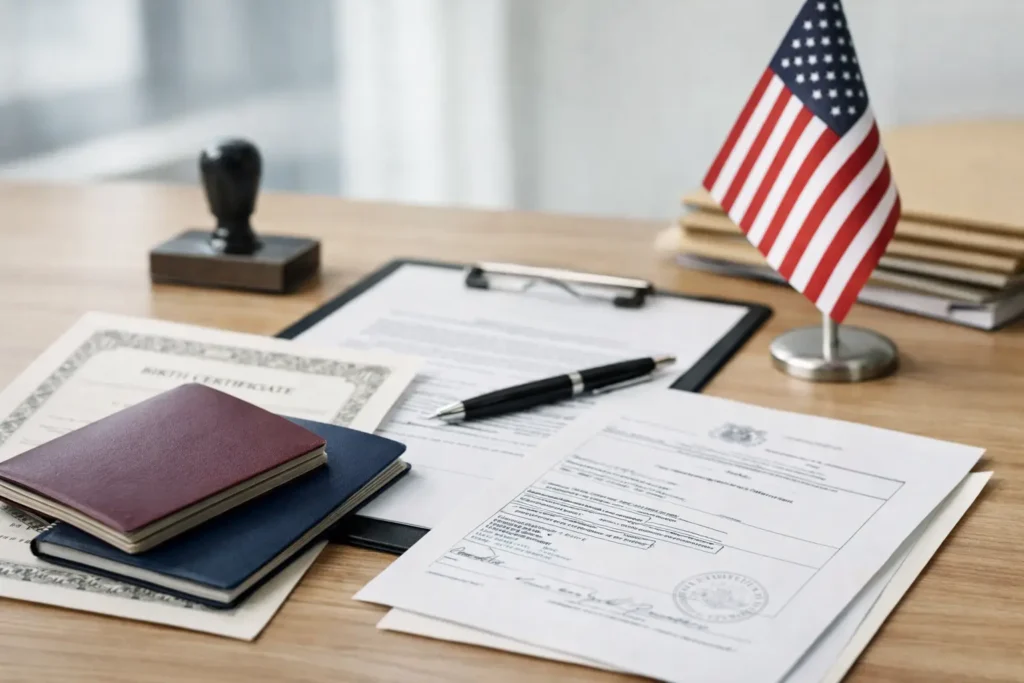
How to Get USCIS Accepted Certified Translation
A green card package can be delayed over something as small as a missing translator certification. That is why people searching for how to get USCIS accepted certified translation in the United States are usually not looking for theory. They need an accurate translation, properly certified, and ready to submit the first time.
For USCIS, the standard is clear but often misunderstood. If a document is not in English, you must submit a full English translation along with a certification from the translator or translation company stating that the translation is complete and accurate, and that the translator is competent to translate from the foreign language into English. Many applicants assume notarization is always required, that a friend can do it, or that any bilingual person with a word processor is enough. Sometimes those assumptions create avoidable problems.
Order Translation Instantly.
How to get a USCIS-accepted certified translation in the United States.
The fastest way to get an acceptable translation is to start with the exact documents you plan to submit and use a professional provider that regularly prepares certified translations for immigration filing. USCIS is not asking for a decorative stamp or a vague promise of quality. It is asking for a complete English translation and a proper certification statement.
That means the translation should match the source document faithfully, including names, dates, seals, stamps, handwritten notes, and any entries that appear on the record. If the original is a birth certificate, marriage certificate, divorce decree, police record, passport page, or academic transcript, the English version should reflect the content in a way that lets USCIS officers review it without guessing.
A USCIS accepted certified translation in the United States usually includes the translated document and a signed certification. The certification confirms three things: the translator is competent, the translation is complete, and the translation is accurate. If any of those elements are missing, the document may be questioned.
What USCIS actually cares about
USCIS cares more about completeness and reliability than flashy presentation. A clean format helps, but acceptance depends on substance. The translation must cover the entire document, not just selected fields. If the original contains stamps, annotations, or side notes, those details should be represented in the translation where relevant.
This is where many DIY submissions fall short. People often translate only the main text and leave out marginal notes, registration numbers, or issuing authority information. Those details can matter. They help confirm what the document is, who issued it, and whether it appears consistent with the rest of the immigration file.
USCIS also expects consistency. If a name is transliterated one way on a birth certificate and another way on a marriage certificate, a professional translator should flag that issue or at least preserve the document faithfully so the applicant and attorney can address it if needed. Accuracy is not just about word choice. It is about preventing confusion across the full case record.
Does USCIS require notarization?
Usually, no. This is one of the most common points of confusion.
For most USCIS filings, a certified translation is required, not a notarised translation. A notarised translation may be helpful in some situations outside immigration, or it may be requested by a court, consulate, school, or foreign authority. But USCIS generally requires the translator certification, not notarization.
That said, some applicants prefer notarization as an added formality, especially when the same document set will be used for multiple purposes. The trade-off is simple: it may add time and cost without changing the USCIS requirement itself. If your translation provider offers both services, make sure you request the one that fits your filing purpose.
Can you translate the documents yourself?
If you are the applicant, do not translate your own documents for USCIS. Even when someone is fluent in both languages, self-translation can create credibility issues.
Can a friend or relative translate them? In some cases, USCIS rules focus on competence and certification rather than requiring a licensed translator. But practical risk matters. If the translation is poorly formatted, incomplete, or uncertified, it can trigger delays or requests for evidence. For high-stakes immigration filings, professional certified translation is the safer choice.
What documents usually need a certified translation
Any non-English document submitted to USCIS should be translated into English. The most common examples include birth certificates, marriage certificates, divorce judgments, death certificates, passports, national ID cards, police clearances, court records, bank records, diplomas, transcripts, and medical documents.
Some applicants only think about civil records, but immigration cases often involve more than that. Adjustment of status, naturalisation, family petitions, waivers, asylum matters, and employment-based filings can all involve supporting records from abroad. If a document is part of the filing and it is not in English, plan to have it translated.
The key is not whether the document seems obvious to you. The key is whether a USCIS officer reviewing the file can read and evaluate it in English.
How to choose the right translation provider
When the goal is how to get USCIS accepted certified translation in the United States, provider selection matters almost as much as the document itself. Look for a company that regularly handles immigration documents, uses human translators, and understands official formatting requirements.
Human translation matters because immigration records often include legal terminology, abbreviations, handwritten entries, and country-specific civil registration language. Machine output may look fluent at a glance while still missing context that affects acceptance. A one-word error in a parental name, place of issue, or marital status can create problems that are expensive to fix later.
A reliable provider should be able to explain what is included, how certification is issued, what the turnaround time is, and whether the final file is ready for USCIS submission. Confidentiality is also essential. These documents contain personal data, immigration history, and family details that should be handled securely.
AL Waseem Translation is one example of a US-based provider that works with certified translations for official use and supports clients who need fast, institution-ready document service.
Signs that a translation is likely to be accepted
A strong USCIS translation package is usually easy to recognise. The translation is complete, professionally formatted, and accompanied by a signed certification statement. Names, dates, and document numbers are clearly rendered. Stamps and seals are identified. Illegible text is marked appropriately rather than guessed at.
It should also be easy to match the translation to the original. If the source document has sections, tables, or entries, the English version should preserve that structure as much as possible. This helps USCIS review the file quickly and reduces the chance of questions.
Red flags that cause avoidable delays
A few warning signs show up again and again. The first is partial translation. The second is missing certification language. The third is poor quality control, especially the inconsistent spelling of names across multiple documents.
Another problem is using generic online templates without checking whether the translator certification is actually signed and complete. Some applicants also submit low-quality scans, which makes even a good translation harder to trust. If the original is blurry, cut off, or unreadable, the translated version cannot solve that on its own.
What the process should look like
In practical terms, the process should be simple. You gather clear copies of the documents, send them to a professional translation company, confirm the purpose is USCIS filing, and review the completed translation for personal details before submission.
That review step matters. Even the best provider works from the source document, and applicants are often the first to notice if a family name should match an existing immigration filing in a specific way. The translator must remain faithful to the original, but identifying potential consistency issues early can help avoid confusion later.
Turnaround time depends on volume, language pair, and document condition. Standard civil records can often be completed quickly. Complex court, medical, or academic files may need more time because terminology and formatting require closer review. If you have a filing deadline, mention it at the start rather than after the order is placed.
Final checks before you submit to USCIS
Before sending your package, make sure each non-English document has a full English translation and a certification statement attached. Verify names, dates, and document numbers against the original. Check that every page is legible and that no attachments were left out.
If your case includes multiple records from different countries or languages, consistency becomes even more important. A professional translation provider can help keep the formatting and certification uniform across the file, which makes the overall submission look more reliable.
When immigration outcomes depend on paperwork, small details are not small. The safest path is to treat translation as part of the legal readiness of your case, not as an afterthought. A properly prepared certified translation gives USCIS what it needs to move your application forward with fewer questions and less risk.