
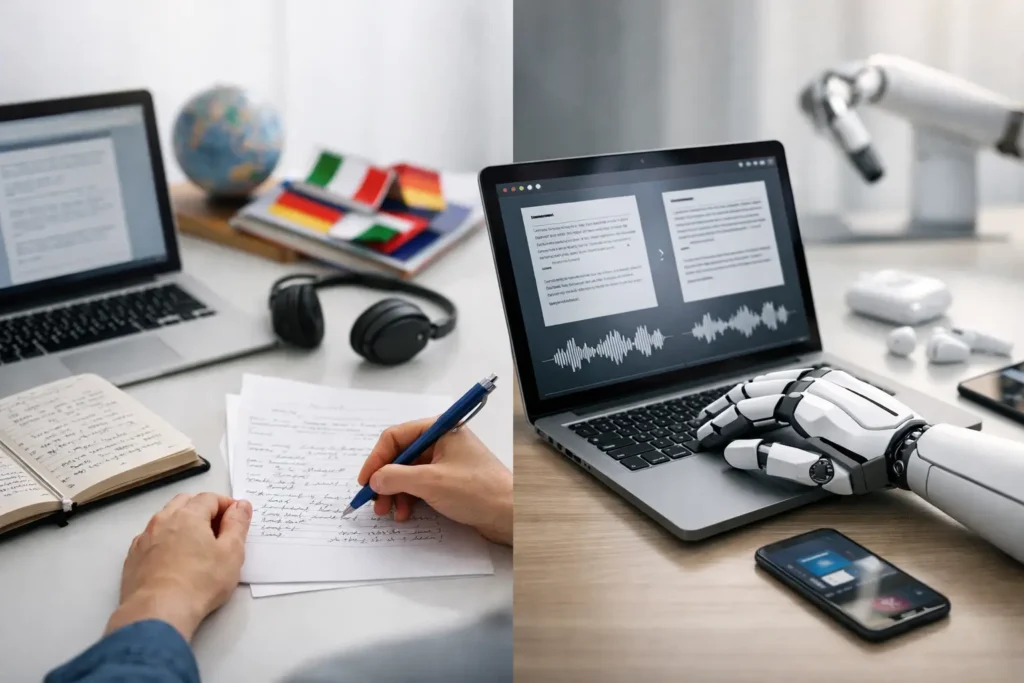
Human Translation vs Machine Translation
A birth certificate for USCIS, a medical report for treatment, or a contract headed to court does not leave room for guesswork. That is where the difference between human translation vs machine translation becomes more than a question of speed or price. It becomes a question of whether your document will be understood correctly, accepted by the right institution, and trusted when it matters most.
For casual content, machine translation can be useful. It helps people get the general meaning of an email, a product review, or a simple message in another language. But official and high-stakes documents work by a different standard. In legal, medical, academic, and immigration settings, the translation must do more than sound close enough. It must be accurate, complete, and appropriate for the purpose it serves.
Order Translation Instantly.
Human translation vs machine translation in real use
The simplest way to understand human translation vs machine translation is to look at how each one works. Machine translation relies on software to process text and predict equivalents in another language. It is fast, scalable, and often good enough for basic comprehension. Human translation relies on a trained linguist who understands grammar, context, tone, terminology, and the intended use of the document.
That difference matters because language is rarely one-to-one. A word can have several meanings depending on the subject matter. A phrase that seems straightforward in everyday use may carry a very specific meaning in a legal filing, a hospital record, or a financial statement. Software can miss those distinctions. A professional human translator is trained to catch them.
This is especially true when formatting, names, stamps, signatures, handwritten notes, and institution-specific wording are involved. A certified translation is not just a text conversion. It is a document prepared for official review. That requires judgment, consistency, and accountability.
Where machine translation works well
Machine translation has a place. For internal reference, quick browsing, or understanding the general idea of foreign-language content, it can save time. Businesses sometimes use it to screen large volumes of material before deciding what needs professional translation. Individuals may use it to understand a message, a menu, or a basic web page.
In those cases, minor wording issues may not create serious consequences. If a sentence is slightly awkward but the reader understands the point, the translation has done its job. The goal is convenience, not official acceptance.
The problem starts when people assume the same tool can handle a marriage certificate, medical diagnosis, diploma, police record, or affidavit with the same reliability. It usually cannot. Machine output may look polished at first glance, but even a small error in names, dates, dosage instructions, or legal terms can cause delays, rejections, or misunderstandings.
Why human translation remains the standard for official documents
Human translation remains the safer choice for documents that will be submitted to USCIS, courts, universities, embassies, hospitals, and government agencies. These institutions do not just want readable text. They want a translation that reflects the original accurately and completely.
A human translator can assess context before choosing terminology. That matters in legal and immigration work, where one phrase can affect the interpretation of a record. It matters in medical translation, where a mistranslated symptom, procedure, or medication detail can create real risk. It matters in academic documents, where grading systems, degree titles, and institutional language need to be rendered carefully.
Human translators also recognize cultural and procedural differences. Some documents contain abbreviations, references, and administrative language that do not translate directly. A skilled professional knows when to preserve the original form, when to clarify, and how to present the information in a way that remains faithful to the source.
Just as important, human translation supports certification and accountability. When a translation must be signed, certified, notarized, or prepared for an agency review, there needs to be a responsible professional process behind it. Software alone cannot provide that level of assurance.
Accuracy is not the same as fluency.
One reason machine translation can be misleading is that it often produces sentences that sound fluent. Smooth wording can create the impression that the translation is correct, even when the meaning is slightly off. In official settings, slightly off is not good enough.
Take a legal document with a term that has a narrow procedural meaning. A machine may choose a common equivalent that reads naturally but changes the legal effect. Or take a medical report where the software confuses a diagnosis with a symptom because the wording is similar in another language. These are not rare edge cases. They are the kinds of errors that happen when context is not fully understood.
A professional human translator reviews the text with purpose. They check terminology, confirm consistency, and preserve the meaning line by line. They also recognize when the original document itself is unclear and handle that situation appropriately rather than guessing.
Cost, speed, and risk
For many customers, the decision between human translation vs machine translation starts with budget and turnaround time. That is understandable. Machine translation is fast and often free or inexpensive. Human translation requires professional labor, review, and quality control.
But the real comparison is not just cost versus cost. It is cost versus risk. If a translated document is rejected by USCIS, questioned by a court, or misunderstood by a hospital, the delay can be far more expensive than the original savings. You may need to order a corrected translation, resubmit paperwork, miss a deadline, or face added stress during an already sensitive process.
For low-stakes content, a faster and cheaper option may be reasonable. For high-stakes documentation, the safer route is usually the more economical one in the long run because it reduces the chance of rejection or confusion.
That is why professional translation providers build their process around more than language conversion. They focus on document readiness, confidentiality, and acceptance requirements. For customers dealing with immigration, legal, medical, or academic paperwork, those details matter as much as the translation itself.
Human translation vs machine translation for USCIS and legal acceptance
If your document is being submitted to an official body, this is where the choice becomes clear. USCIS, courts, embassies, and many other institutions expect complete and accurate translations prepared in a way that meets formal requirements. A rough automated version is not enough.
Certified translation typically requires a statement affirming that the translation is complete and accurate and that the translator is competent to translate from one language to another. That is a professional responsibility. Machine translation tools do not meet that standard on their own.
The same applies to many legal and notarized use cases. A translated affidavit, court filing, contract, or identity record may need not only linguistic accuracy but also proper presentation and supporting certification. When acceptance is the goal, human expertise is not a luxury. It is part of the requirement.
This is one reason many clients choose a provider such as AL Waseem Translation for official-use documents. The value is not simply that a person translates the text. The value is that the document is prepared for real-world submission, with the accuracy and professionalism that those institutions expect.
The best choice depends on the stakes
There is no need to treat machine translation as useless or human translation as necessary for every single text. The better approach is to match the method to the purpose.
If you need to understand the general meaning of informal content, machine translation may be sufficient. If you need a polished marketing message, a sensitive medical report, a certified birth certificate translation, or a legally dependable contract translation, human translation is the better choice.
A practical question helps clarify the decision: what happens if this translation is wrong? If the answer is not much, automation may be enough. If the answer involves rejection, delay, liability, or personal stress, a qualified human translator is the smarter option.
When documents affect immigration status, healthcare decisions, education, employment, or court proceedings, accuracy is not optional. The right translation should do more than convert words. It should give you confidence that your document will be clear, credible, and ready for the institution that receives it.
If you are deciding between speed and certainty, remember that the best translation is the one that works the first time.