
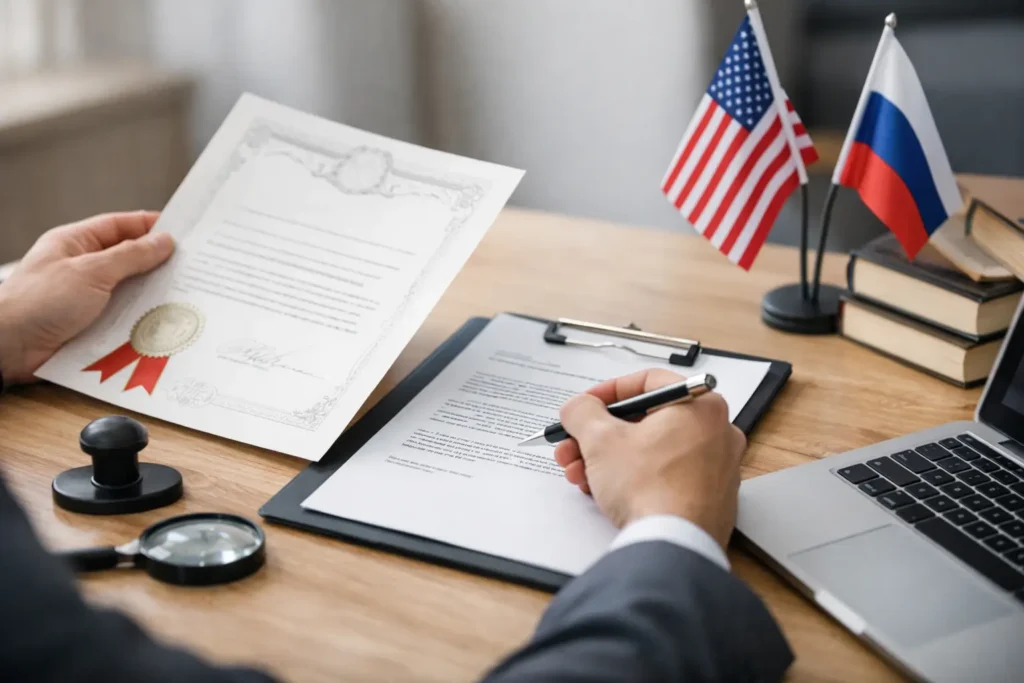
A diploma can look simple on paper, but the moment you need to use it in the United States for immigration, education, licensing, or employment, the details matter. The certified diploma translation process is not just about changing words from one language to another. It is about producing a complete, accurate, institution-ready translation that can stand up to formal review.
If you are submitting academic records to a university, licensing board, employer, court, or USCIS, small mistakes can create delays you did not plan for. A missing stamp, an untranslated note, a name mismatch, or the wrong certification format can turn a straightforward request into a time-sensitive problem. That is why it helps to understand how the process works before you send anything out.
What the certified diploma translation process actually includes
A certified diploma translation is a human translation of your diploma or academic certificate that comes with a signed certification statement confirming that the translation is complete and accurate to the best of the translator’s knowledge. In many cases, the translated document must mirror the source document closely, including seals, signatures, handwritten notes, official headings, and formatting cues that affect meaning.
This is where many people get tripped up. They assume a translated diploma is enough. Often, it is not. The receiving institution may require certification, and in some situations, notarization or apostille support may also be part of the broader document workflow. Those are separate services, and the right combination depends on who will receive the document.
For example, a university admissions office may accept a certified translation but still require a credential evaluation from a separate evaluator. A state licensing board may want certified translation first, then additional review. USCIS generally requires certified translations for foreign-language documents, but not every immigration-related submission has the same practical expectations. The rule is simple: translation accuracy is mandatory, while extra formalities depend on the end use.
When a diploma translation needs certification
Certification is usually needed when your diploma will be reviewed for an official purpose. Common situations include college admissions, transfer applications, employment verification, immigration filings, professional licensing, and court matters involving academic records.
If your diploma is not in English and it will be submitted to a US institution, certification is often the safest path. Some schools and agencies are explicit about this. Others simply say that documents must be translated accurately by a qualified translator. In practice, a properly certified translation reduces the risk of rejection because it gives the reviewer a formal statement of completeness and accuracy.
The key point is that certification is about acceptability. It tells the recipient that the translation was prepared responsibly and is intended for official use. It is not a decorative attachment. It is part of what makes the document usable.
Step by step: how the certified diploma translation process works
1. Document review and intake
The process starts with a review of the diploma itself. A professional translation provider checks the language, document type, legibility, number of pages, and any special features such as seals, watermarks, signatures, handwritten notes, transcripts attached to the diploma, or institutional stamps.
This first step matters more than most clients expect. If the image is blurry or cropped, the translator may not be able to read every element. If there are front-and-back pages, both may need translation. If a transcript or supplement is part of the same submission, it may be better to translate everything together so names, dates, and academic terminology stay consistent.
2. Quote, timeline, and service scope
After review, the provider confirms pricing, turnaround time, and whether you need only certification or also notarization, apostille support, or translation of related academic records. This is where clarity helps. If the diploma is going to USCIS, a university, or a foreign consulate, say so early.
The destination can affect formatting and supporting paperwork. A fast turnaround may be possible, but speed should not come at the expense of accuracy. Official academic documents need careful handling, especially when degree titles, honors, ministry references, or institutional abbreviations do not have a direct English equivalent.
3. Human translation by a qualified linguist
The actual translation should be completed by a human translator with experience in official documents. Diplomas are short compared to contracts or medical files, but they can contain terminology that requires precision. Academic rank, degree level, faculty name, field of study, graduation status, and issuing authority all need to be rendered correctly.
This is one reason human-only translation remains essential. Literal translation can create the wrong meaning, while over-interpreting can create wording the original never stated. A good translator finds the balance between accuracy and institutional readability.
4. Quality review and consistency check
Once the translation is drafted, it should go through review. Names are checked against the source. Dates are confirmed. Numbers, reference codes, and institutional names are verified. Stamps and seals are marked appropriately, often with bracketed descriptions such as [seal] or [signature], depending on the format used.
This stage is critical when the diploma uses a non-Latin alphabet or when the person submitting the document has multiple English spellings of their name in passports, IDs, or immigration records. A translation provider may ask which spelling should be used to match your official US-facing documents. That simple question can prevent major submission issues.
5. Certification statement preparation
After review, the certified translation package is finalized with a signed certificate of accuracy. This certification usually states that the translator or translation company is competent in both languages and that the translation is complete and accurate to the best of their knowledge and ability.
The wording should be professional and suitable for official use. Some recipients care a great deal about this. Others focus more on whether the translation appears complete and credible. Either way, missing or weak certification language can create avoidable back-and-forth.
6. Delivery in the required format
The completed translation is usually delivered as a digital PDF, and in some cases as a printed hard copy if the receiving institution requests it. Some clients need a scan for online submission. Others need an original signed copy by mail. If notarization is required, that changes the delivery process and should be arranged before final release.
A dependable provider will make this clear up front instead of leaving you to guess what kind of copy is acceptable.
Common problems that delay acceptance
The most common issue is incomplete translation. People often assume only the main diploma text matters, but reviewers may want every visible element translated, including stamps, registrar notes, legends, and handwritten annotations. If part of the document is ignored, the recipient may question the completeness of the entire file.
The second issue is inconsistency in names. If your diploma shows one spelling, your passport another, and your university application a third, the translation alone cannot fix that. It can, however, follow the source while aligning with your preferred official spelling where appropriate. That needs to be handled carefully.
The third issue is using non-professional or automated translation for an official submission. That might seem faster at first, but it often creates more cost later when a document must be redone correctly under deadline.
Certified translation vs notarization vs apostille
These terms are often confused, and they are not interchangeable. A certified translation is the translated document plus a certification statement. Notarization generally means a notary acknowledges the signature on the translator’s or company’s certification statement. An apostille is a separate authentication step used for international document recognition under specific legal frameworks.
For a diploma translation being used inside the US, certified translation is often the main requirement. If the translated diploma will be used abroad, or if a consulate, ministry, or foreign institution has additional formalities, notarization or apostille support may become relevant. It depends entirely on the receiving authority.
How to prepare your diploma for translation
Start with a clear, complete scan or photo of the document. Make sure every corner is visible and nothing is cut off. Include the reverse side if there is any text, stamp, or notation there. If you also have transcripts, degree supplements, or name change documents, gather them at the same time.
Then confirm where the translation is going. A university, licensing board, employer, and immigration agency may all ask for the same diploma but expect different supporting steps. When the end use is known from the beginning, the translation can be prepared with fewer revisions and less risk.
If you are working with a professional service such as AL Waseem Translation, ask directly whether the package includes certification, whether notarization is available if needed, and how quickly the final version can be delivered for your deadline.
Why the process matters more than the page count
A diploma is usually a short document. That can make people underestimate the stakes. But short official documents often receive more scrutiny because every line carries weight. Degree title, issuing authority, date of graduation, and institutional seal can affect admission, employment, immigration review, or licensing eligibility.
A careful certified diploma translation process protects you from preventable delays. It gives the receiving institution a document that reads clearly, reflects the original faithfully, and includes the formal certification expected for official use.
When your education records are tied to a deadline or a major life step, the smartest move is usually the simplest one: get the translation done correctly the first time.