
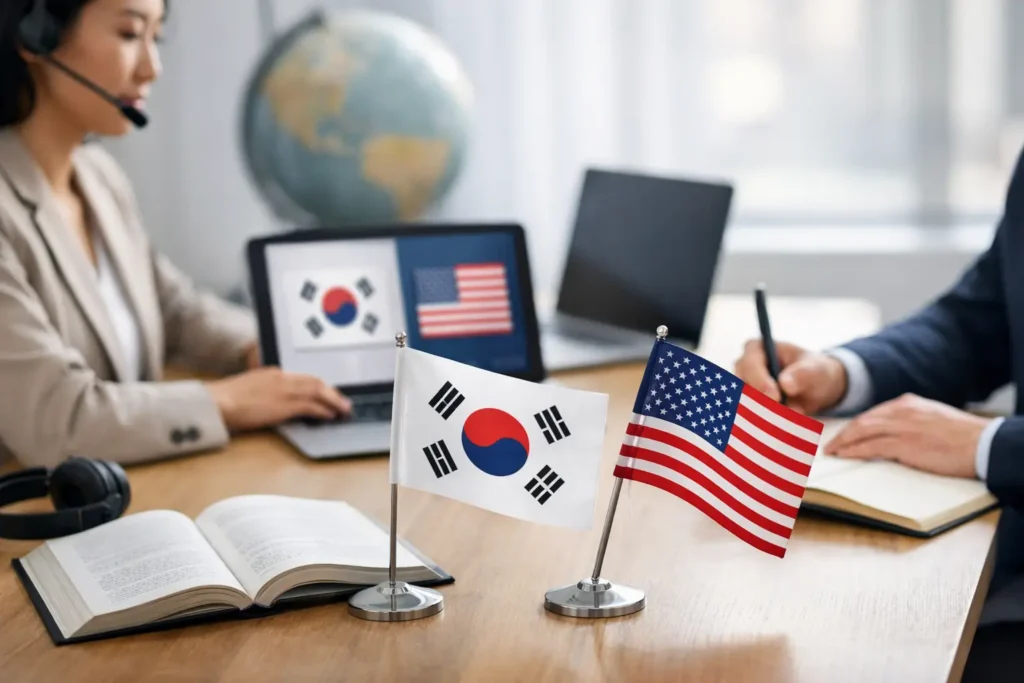
Korean Language Translation by Al Waseem
A single mistranslated date on a family registry, diploma, or medical report can slow down an immigration case, create problems in court, or force you to resubmit paperwork. That is why Korean language translation is not just about converting words from one language to another. For official use in the United States, it must be accurate, complete, and prepared in a manner that institutions will accept.
Korean is a language where context matters. A translator has to recognise not only vocabulary but also naming order, honorifics, government document formats, and how meaning changes depending on who is speaking and why. When the document is headed to USCIS, a court, a university, a hospital, or an employer, those details are not minor. They are often the difference between acceptance and delay.
Order Translation Instantly.
📑 Table of Contents
When Korean language translation needs more than fluency
Many people assume a bilingual speaker can handle a document translation. That may be true for casual communication, but official documentation is a different standard. A marriage certificate, court filing, vaccination record, or corporate agreement has to reflect the source text faithfully, including stamps, handwritten notes, seals, and formatting cues that may carry legal meaning.
Korean documents also present structural challenges. Personal names may appear in a different order than English naming conventions. Addresses can be formatted in ways that do not map neatly onto US forms. Government-issued records may use administrative terminology that sounds simple at first glance but has a specific legal function. A translator who works with official documents knows when to preserve wording closely and when to clarify meaning in a way that remains accurate.
This is especially important for certified translation. In most official settings, the translated document must be accompanied by a signed certification stating that the translation is complete and accurate to the best of the translator's knowledge. That certification is not decoration. It is often what makes the translation usable for USCIS, courts, schools, and agencies.
Common documents that require Korean language translation
The need usually starts with a deadline. Someone is applying for a visa, responding to a request for evidence, enrolling in school, preparing a lawsuit, or submitting records to a medical provider. In those moments, the translation has to do two jobs at once - it has to be linguistically correct and procedurally ready.
For individuals, the most common requests include birth certificates, marriage certificates, divorce judgments, passports, family relation certificates, academic transcripts, diplomas, police records, bank statements, and medical records. For businesses and institutions, it may involve contracts, compliance documents, technical manuals, employee records, research materials, or financial reports.
Each category comes with different expectations. A medical translation must preserve terminology with extreme care because treatment decisions can depend on it. A legal translation has to maintain exact meaning because a small wording shift can affect rights and obligations. An academic translation must reflect grades, coursework, and institutional terminology clearly enough for admissions offices or licensing bodies to assess it properly.
Certified translation vs. regular translation
One of the biggest points of confusion is whether a translation simply needs to be readable or officially certified. If the document is for personal reference, an uncertified translation may be enough. But if you are submitting it to USCIS, a court, a university, or another formal institution, a certified translation is usually the safer choice.
Certified translation means the completed translation is delivered with a signed statement affirming accuracy and completeness. Some cases also call for notarization or apostille support, depending on where the document will be used and what the receiving authority asks for. The requirement is not the same in every situation, which is why it helps to confirm exactly what the receiving institution expects before ordering the service.
There is a practical trade-off here. Some clients want the fastest possible turnaround and assume a simple translation is enough. Others over-order services they do not actually need. The right approach depends on the end use. For a USCIS filing, certification is generally essential. For overseas submission, notarization or apostille may matter. For internal business use, a professionally translated file without extra formalities may be sufficient.
Why human translators matter for Korean documents
For high-stakes documentation, human-only translation is still the reliable standard. Automated tools can help with a rough understanding, but they are not dependable for official records. Korean includes nuances in tone, syntax, and document conventions that software often misreads, especially when scans are unclear, or the source includes seals, handwritten marks, or outdated terminology.
A machine may produce something that looks fluent while quietly changing the meaning of a relationship term, legal status, or medical condition. That kind of mistake can be expensive. It can trigger rejections, follow-up questions, or loss of time when the matter is already urgent.
A trained human translator does more than convert text. They evaluate context, identify ambiguities, follow official formatting expectations, and maintain consistency across names, dates, and terminology. If a Korean certificate uses a phrase that has no direct word-for-word equivalent in English, a skilled translator will render it in a way that preserves the legal or administrative meaning rather than guessing.
How to choose a Korean language translation provider
The right provider should be able to answer a few basic questions clearly. Do they offer certified translation for official use in the United States? Do they use human translators with subject-matter experience? Can they handle legal, medical, academic, and immigration documents accurately? Do they understand confidentiality requirements and fast turnaround expectations?
You should also look at the process, not just the price. A dependable provider explains how to submit documents, how certification is issued, and whether notarization or apostille support is available if needed. They should be comfortable working from scans by email, online uploads, mailed originals, or in-person drop-off, depending on your situation.
Turnaround time matters, but speed should not come at the expense of acceptability. If a provider promises instant delivery for a complex court record or medical file, that is usually a red flag. Some documents can be completed quickly, but quality review still matters. The better question is whether the provider can move fast while maintaining accuracy and compliance.
What accuracy looks like in practice
Accurate translation is not just about dictionary meaning. It means matching names exactly across supporting records, preserving date formats correctly, translating seals and annotations, and reflecting missing or illegible text transparently when necessary. It also means keeping the translation complete. Omissions, even small ones, can cause trouble later.
For example, a Korean family relation certificate may contain details that seem secondary to the client but matter to the receiving agency. A translator cannot decide to leave out a notation because it looks repetitive. In official translation, completeness is part of accuracy.
Formatting also plays a role. While the English version does not need to imitate the original perfectly, it should be organised enough for a reviewer to understand what corresponds to what. Clear labels, consistent terminology, and properly translated seals help officials process the file with less friction.
Korean translation for USCIS, courts, and other official use
USCIS and other government-facing institutions care about two things at once - readability and reliability. They need to understand the content, and they need confidence that the translation reflects the source document fully. That is why certified translation is a routine requirement in immigration matters.
Courts, embassies, consulates, schools, and licensing boards may each have their own expectations. Some accept standard certified translations. Others may request notarization, original signatures, or additional supporting steps. There is no one-size-fits-all rule, which is why experience with official workflows matters as much as language ability.
This is where a service-oriented provider adds real value. A company such as AL Waseem Translation is built around institution-ready documentation, which means the translation process is designed not only for linguistic accuracy but also for formal acceptance, confidentiality, and quick turnaround when deadlines are tight.
If you need a Korean language translation, the safest move is to treat the document according to its purpose, not just its language. A personal paper can become a legal file the moment you submit it. Getting it right the first time is often the fastest path forward.
Any queries?
Click Here to Get Your Free Quote Now.
f
✆
in
𝕏