
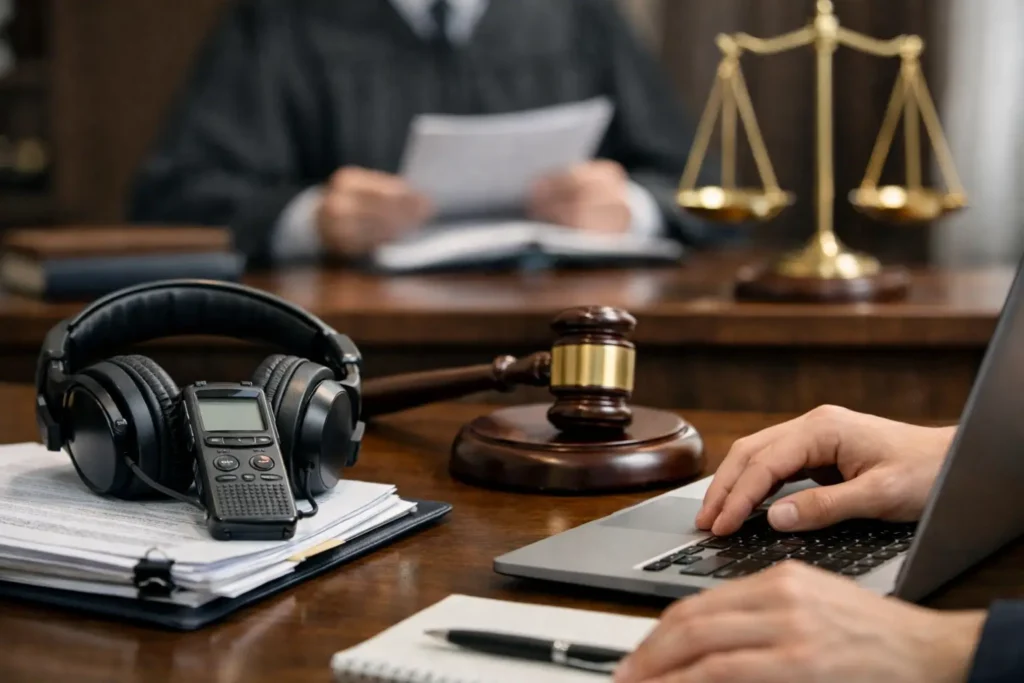
A legal transcription project example is most useful when it shows what happens between an unclear recording and a document a legal team can confidently review, quote, file, or prepare for translation. Legal audio is rarely clean. It may include overlapping speakers, interruptions, poor phone connections, technical terminology, and statements that must be captured without changing their meaning.
Consider a law firm preparing for a civil hearing involving a disputed business agreement. The attorney has a 47-minute recorded interview between a client, a former business partner, and counsel. The recording may support a timeline of events, but it cannot be efficiently searched, cited, or shared with the legal team in audio form. The assignment is to create an accurate, clearly formatted transcript that preserves the record while making the conversation usable.
Legal Transcription Project Example: A Recorded Interview
The first step is intake. The client provides the audio file, confirms the purpose of the transcript, identifies known speakers, and specifies any required formatting. For legal matters, these details are not administrative extras. They determine whether the final transcript will be practical for attorney review and appropriate for the intended setting.
In this example, the client requests a verbatim legal transcript with timestamps every 30 seconds and speaker identification. They also ask that any unintelligible audio be marked rather than guessed. The requested format is Microsoft Word, with page numbers, line numbering, and a clear case reference on each page.
A project brief might read as follows:
- Source file: 47-minute English-language recorded interview
- Speakers: Attorney, Client, Former Partner
- Purpose: Internal legal review and hearing preparation
- Style: Verbatim, including false starts and material interruptions
- Formatting: Timestamps, speaker labels, page and line numbers
- Delivery: Editable Word document and searchable PDF
The transcriptionist does not assume that every pause, filler word, or background sound belongs in the document. Verbatim transcription is not the same as indiscriminate transcription. The agreed style determines what is retained. In a legal context, a repeated phrase, interruption, or hesitation may matter because it affects how a statement is understood. The transcriptionist follows the project instructions consistently rather than making editorial choices based on personal preference.
Sample Transcript Format
A portion of the finished transcript could appear like this:
“`text [00:12:30] ATTORNEY: When did you first learn that the payment had not been sent?
CLIENT: I believe it was on March 3rd. I checked the account that morning and there was nothing there.
FORMER PARTNER: That is not exactly right. We discussed a delay the week before.
CLIENT: We discussed a possible delay. You did not tell me the payment was being withheld.
[00:13:00] ATTORNEY: Please let her finish her answer.
CLIENT: Thank you. I received an email later that day stating that the funds would be released after approval. “`
The formatting gives each speaker a clear voice without changing the wording. Timestamps allow counsel to return to the exact point in the recording. If an important passage is challenged, the legal team can compare the text against the source audio immediately.
If a section cannot be heard clearly, the correct treatment is transparency. For example, the transcript may read, “[inaudible 00:18:42]” or “[unintelligible]” based on the recording and the client’s style requirements. A legal transcriptionist should never fill a gap with a likely word simply because it appears to fit the conversation. A plausible guess can become a serious factual error.
Quality Control Is Part of the Legal Record
Legal transcription requires more than fast typing. The initial draft should be reviewed against the recording, especially where names, dates, dollar amounts, addresses, legal terminology, or disputed statements appear. In the project example above, the reviewer would carefully confirm whether the client said “March 3rd” rather than “March 13th,” and whether the former partner said payment was “delayed” or “withheld.” Those distinctions can affect case strategy.
Quality control also checks that speaker labels remain consistent, timestamps match the audio, and formatting does not create confusion. If the client names a speaker incorrectly or cannot identify a participant, that uncertainty should be represented accurately. A label such as “UNIDENTIFIED MALE SPEAKER” is better than assigning a name without confirmation.
Confidentiality is equally central. Recordings can contain attorney-client communications, medical details, employment information, financial records, and allegations that have not been tested in court. A professional provider should use controlled handling procedures and limit access to the people working on the assignment. Convenience should not come at the expense of sensitive information.
Verbatim, Clean Verbatim, or Edited: Which Is Right?
The right style depends on the legal purpose. A verbatim transcript retains speech patterns, repetitions, interruptions, and nonverbal sounds where relevant. It is often appropriate for interviews, depositions, recorded statements, and evidence review.
Clean verbatim removes some verbal clutter, such as repeated filler words, while preserving the speaker’s intended meaning. It may work well for internal summaries or meetings where readability is more important than a word-for-word record. However, it should not be used when counsel needs a precise record of how something was said.
Edited transcription is generally better suited to presentations, reports, or business content. It can improve grammar and organization, but that editorial approach may be unsuitable for evidentiary material. When the transcript could be scrutinized by opposing counsel, an agency, or a court, the safest approach is to establish the required style before transcription begins.
When Certification, Translation, or Notarization May Be Needed
Not every legal transcript requires certification or notarization. The requirement depends on the court, agency, attorney, jurisdiction, and purpose of the document. A transcript used only for internal case review may need accuracy and confidentiality but no formal certification.
If the transcript is intended for submission, the requesting attorney or institution may require a certification statement from the transcription provider. This statement typically confirms that the transcript is a true and accurate representation of the audio to the best of the transcriber’s ability. It does not transform unclear audio into clear evidence, and it does not replace an official court reporter’s transcript when a court specifically requires one.
The workflow becomes more involved when the recording is in another language. In that situation, the provider must first determine whether the client needs a transcription in the source language, an English translation, or both. For official use, it is often best to retain the source-language transcript and provide a separate certified English translation. This creates a clearer chain from the original recording to the translated document.
Notarization may also be requested, but it is not automatically necessary. A notary verifies the identity of the person signing a statement. It does not independently verify the accuracy of the transcript or translation. Clients should confirm the receiving institution’s requirements before ordering additional services.
What Clients Should Provide Before Work Begins
A well-prepared request reduces delays and prevents avoidable revisions. The client should provide the clearest available audio file, the case name or reference number, speaker names if known, and the intended use of the transcript. If there are spellings for names, companies, medications, technical terms, or locations, those should be supplied at the beginning.
It also helps to state whether the transcript is needed for attorney review, discovery, a hearing, an immigration matter, a corporate investigation, or another official purpose. A turnaround deadline matters, but so does the reason for the deadline. A same-day internal draft and a carefully reviewed transcript for formal submission may require different production plans.
For multilingual legal matters, clients should identify the language and regional variety spoken in the recording whenever possible. Spanish, Arabic, Chinese, and many other languages can vary by region, vocabulary, and pronunciation. The right language professional improves both accuracy and efficiency.
A reliable legal transcript gives attorneys and clients a practical record they can search, assess, and prepare around. Whether the project involves one recorded interview or hours of multilingual evidence, clear instructions, qualified human transcription, and careful review protect the meaning of the original audio. AL Waseem Translation can help clients organize transcription and certified language services for documents that need to be ready for legal and official use.